
Four Conversations Government Finance Teams Should Have Before Year-End
GASB 103 is required for fiscal years ending June 30, 2026, and thereafter, and it changes how government entities present and explain several parts of their financial statements.
For many finance teams, most of the information needed for GASB 103 already exists. The challenge is identifying the changes that matter and documenting why they occurred. The answers often come from conversations with budget owners, department leaders, grant administrators and others who understand the story behind the numbers.
Those conversations require coordination across the finance team and the organization. Starting them early gives decision-makers time to provide context before they turn their attention to other priorities.
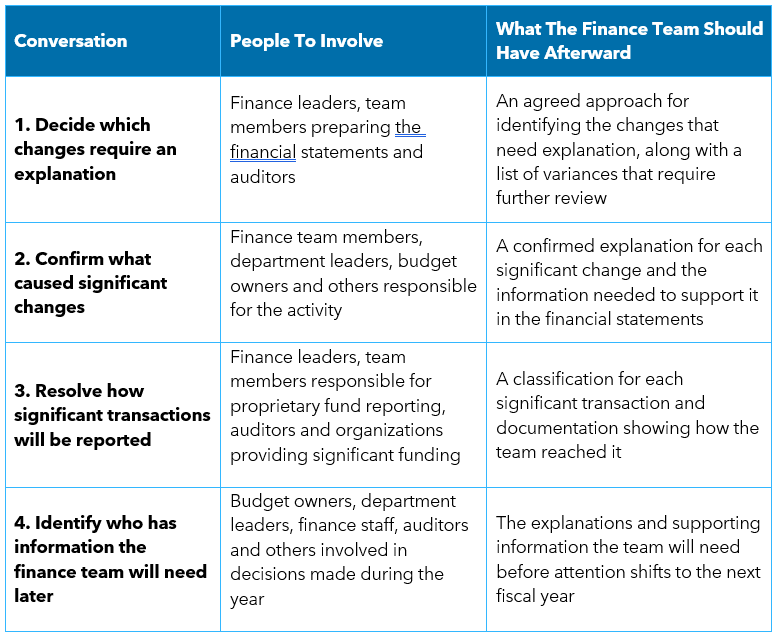
The following four conversations can help finance teams make informed reporting decisions and gather what they need before financial statement preparation and audit fieldwork begin.
Conversation 1: Decide Which Changes Require an Explanation
GASB 103 requires finance teams to explain significant changes in government-wide financial results, including why they occurred and the size of the change. Budgetary comparison information will also need to explain significant differences between the original budget, final budget and actual results.
Finance teams may identify dozens of year-over-year changes, but not every fluctuation requires explanation in the financial statements. An agreed definition of significance helps the team focus its analysis on the changes readers are most likely to care about.
A quantitative threshold based on revenues, expenditures, assets or another primary measure can set a consistent starting point. Professional judgment can then capture a smaller change that still matters because of its nature or context.
That direction keeps the team from overanalyzing immaterial fluctuations while significant variances go unexplored.
Conversation 2: Confirm What Caused Significant Changes
Once your team identifies the changes that require explanation, you’ll need to understand what caused them. GASB 103 requires finance teams to explain why significant changes occurred. Reporting the amount and percentage of a change won’t give readers enough information to understand what actually happened.
Identifying a variance is usually the easy part. The first explanation is not always the right one. A decline in revenue may appear to reflect reduced activity, but follow-up questions could reveal a reporting change, program restructuring or funding shift.
For a public college or university, a revenue change could stem from enrollment trends or a shift in the mix of tuition-paying students. Changes in state appropriations or investment performance may also be responsible. The explanation should identify the factor that actually drove the variance rather than simply restate the amount.
Because the general ledger rarely tells the full story, finance may need to test an initial explanation with the department or program leaders who understand the activity. The goal is to confirm the underlying cause, not simply describe the movement in the account.
A confirmed explanation reduces revisions and gives financial statement users more useful information than an assumption based on the numbers alone.
Conversation 3: Resolve How Significant Transactions Will Be Reported
GASB 103 changes where proprietary funds report certain revenues and expenses, and it requires noncapital subsidies to appear separately in the financial statements.
Some classifications will be straightforward. Others depend on how a funding arrangement was designed and may require information from a grantor, funding agency, component unit or other external organization.
For significant revenue sources, grants, transfers and other funding arrangements, the classification may depend on whether goods or services were provided in return. Finance teams may also need to determine whether the funding was intended to keep rates or charges lower or was restricted for capital purposes. Accounting records alone may not answer those questions.
For example, funding received by a utility may look like operating revenue at first. If the funding was provided to keep customer rates lower rather than in exchange for services, it may require a different classification.
Resolving the arrangement’s purpose gives the team time to document its conclusion and avoid reopening a major reporting decision during drafting.
Conversation 4: Identify Who Has Information the Finance Team Will Need Later
The final conversation is about ownership. Budget owners can explain why the original budget changed. Department leaders can account for differences between actual results and expectations. Auditors may already have useful context from procedures completed during the audit. Finance should identify who holds each piece of information and when it will be collected.
For example, the person who approved a budget revision six months ago may be focused on new priorities by year-end and less likely to remember the reasoning behind it. Capturing that explanation now can save time later and help the final disclosure tell a complete, accurate story.
Learn More About GASB 103 Changes
While GASB 103 introduces new reporting requirements, many governments already perform much of the underlying analysis through budgeting, financial reporting and audit processes. The harder task is documenting why a change occurred and securing the right information while the details are still current.
Finance teams that begin these conversations early will be better prepared to explain significant variances and support their reporting decisions. They can also provide financial statement users with more meaningful information. Waiting until drafting begins may force teams to reconstruct explanations after key stakeholders have shifted their attention elsewhere.
To learn more, contact your Warren Averett advisor directly, or ask a member of our team to reach out to you.
