
The 48 CFR Rule Is Here: Are You Ready for the DoD’s New Cybersecurity Standard?

For both prime contractors and subcontractors, your cybersecurity posture now directly impacts your next contract opportunity.
Cybersecurity Maturity Model Certification (CMMC) compliance has transitioned from a recommended best practice to a mandatory contractual requirement under federal acquisition regulations.
The DoD’s final rule amending the Defense Federal Acquisition Regulation Supplement (DFARS) went into effect on November 10, 2025. The CMMC requirements are immediately enforceable, so contractors without proper compliance status posted in the Supplier Performance Risk System (SPRS) are already being excluded from contract awards.
The 48 CFR rule establishes specific DFARS clauses that flow compliance requirements throughout the defense supply chain. If you handle Federal Contract Information or Controlled Unclassified Information (CUI), these requirements now directly impact your eligibility to compete for and maintain DoD contracts.
Understanding the Phased Rollout of CMMC Requirements
The DoD is implementing CMMC requirements in three distinct phases. Each phase expands the scope and rigor of compliance expectations, so understanding where your organization is in this timeline is essential for planning your compliance strategy.
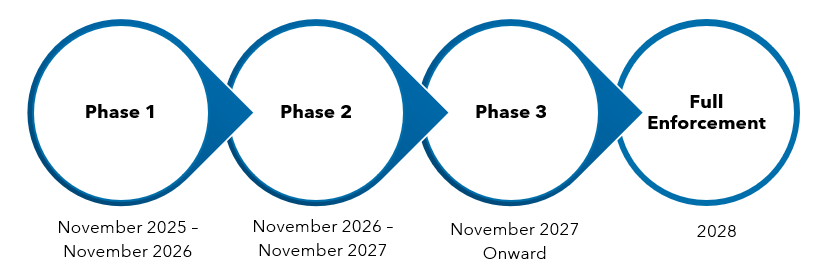
Phase 1: November 2025 – November 2026
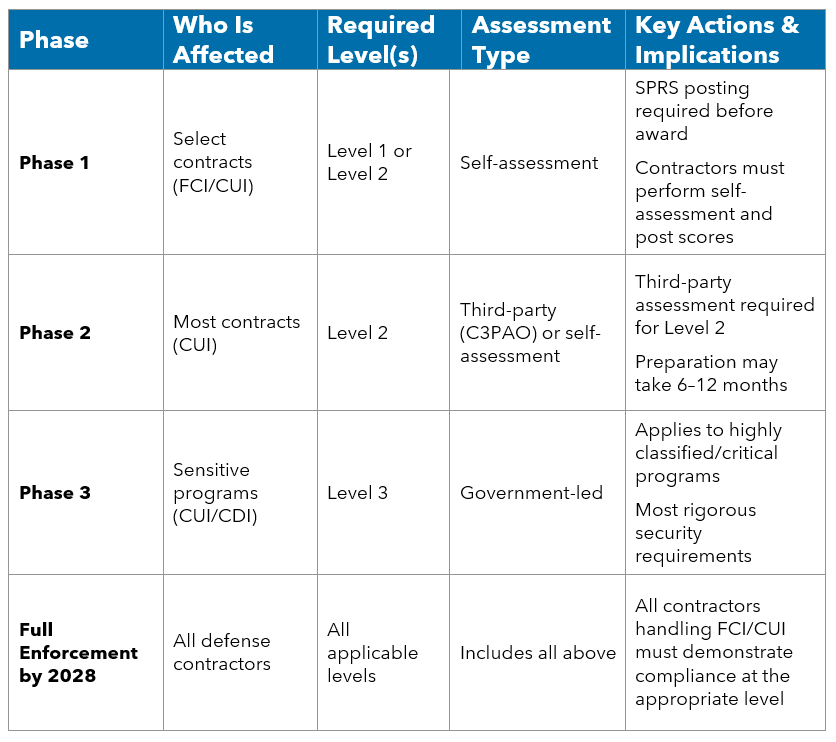
The first phase applies to select contracts and requires Level 1 or Level 2 self-assessments with SPRS to be posted before the contract award. If you’re pursuing contracts during this phase, you need self-assessment capability and SPRS access as soon as possible.
CMMC Level 1 addresses basic cyber readiness with 17 safeguarding requirements. Level 2 aligns with NIST SP 800-171, requiring an assessment of 110 security practices. During Phase 1, both levels allow self-assessment, but that changes in Phase 2. Contracts are being awarded with these requirements, and contractors without compliant SPRS entries are being passed over.
Phase 2: November 2026 – November 2027
Phase 2 expands coverage to most contracts involving CUI and requires third-party assessments for Level 2 certification. This means if you handle CUI, you will need an assessment by a CMMC Third Party Assessor Organization (C3PAO).
Third-party assessments involve more time, preparation and investment than self-assessments. A C3PAO must conduct thorough evaluations of your security controls, documentation and processes. Many organizations need six to twelve months of preparation before they’re ready for successful C3PAO assessment.
Phase 3: November 2027 Onward
Phase 3 introduces Level 3 assessments for the most sensitive national security programs, specifically those requiring the most enhanced security measures. These contracts may involve CUI or Covered Defense Information (CDI) associated with breakthrough or advanced technology, significant aggregations of sensitive data, or systems where a single breach could create widespread DoD vulnerabilities. These assessments involve government-led evaluation and apply to a smaller subset of contractors working on highly classified or critical national security programs.
Full Enforcement by 2028
By 2028, the DoD expects full enforcement across all applicable contracts. Every defense contractor handling FCI or CUI will need to demonstrate compliance at the appropriate level.
The Costs of Noncompliance
No compliance means no new contracts. Now, only contractors with proper certification or assessment scores posted in SPRS can receive awards. Technical expertise, competitive pricing, past performance and established relationships will not override the requirement.
Many contractors assume their current contracts are protected, but when contracts come up for option years or extensions, those exercises may require updated CMMC compliance verification. If you haven’t maintained compliant status, the government may decline to exercise options, effectively ending your contract early.
False reporting in SPRS can trigger False Claims Act liability and substantial penalties. The False Claims Act imposes severe consequences for knowingly submitting false information to the government, and SPRS compliance status qualifies as such information. If your organization claims compliance but has not actually implemented required security controls, that misrepresentation creates significant legal exposure. Penalties under the False Claims Act can reach three times the government’s damages plus additional fines per violation.
Perhaps most concerning for business sustainability, non-compliant firms risk permanent exclusion from the Defense Industrial Base. As compliant competitors capture available contracts, non-compliant organizations lose revenue and relationships. The longer you delay, the harder it becomes to recover your market position.
Prime contractors have to adjust their supplier networks to prioritize CMMC-compliant subcontractors. If you’re a subcontractor, your prime contractor customers may begin sourcing from your compliant competitors because they have no choice. CMMC compliance has become a basic credential for participating in defense work.
Navigate the 48 CFR Rule with Confidence
Achieving CMMC certification requires the understanding of defense regulations, assessment procedures, strategic implementation planning and much more. Expert guidance makes the difference between efficient progress and costly delays.
Warren Averett Technology Group understands the unique challenges facing defense contractors and can provide solutions that fit your operational realities and budget constraints. We can help you assess your current compliance status and create a strategic path to certification. Schedule a consultation with Warren Averett Technology Group to discuss your CMMC compliance strategy with an experienced advisor.
