
Before You Roll Out AI in Your Business: Picking a Use Case That Won’t Backfire

Many companies are launching AI initiatives in hopes of gaining efficiencies, but not everyone is seeing results from their AI investments. Despite the widespread buzz and fast-paced adoption, most (a staggering 95%) of AI pilots fail and produce no actual ROI.
The difference between a failed AI initiative and a successful one often comes down to the project’s purpose, planning and overall use case.
Companies that see real returns tend to move deliberately, which is really what drives both the payoff on the investment and the time savings. Plus, if your team is already stretched thin or uneasy about how AI might affect their roles, a poor first-use case and rollout can also create skepticism that affects every future AI effort, leading to wasted costs and added resistance across the organization.
Internal excitement or novelty is not enough to justify an AI effort. Choosing a strong AI use case must depend on the measurable impact it can deliver and how realistically you can execute it.
This article outlines a practical way to filter and evaluate ideas so you can rule out weak options early and move forward with a successful AI use case that has what it takes to succeed (and actually benefits your organization).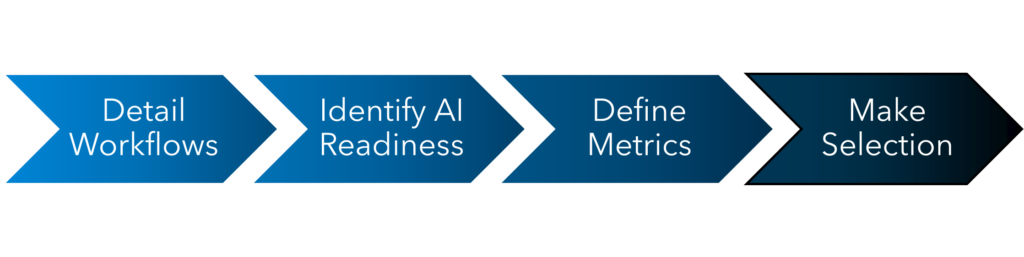
Step 1. Start With a Workflow Map (Not a List of AI Ideas)
Most AI initiatives incorrectly begin by brainstorming what AI could do. Instead, you should first consider what your company does.
Start by picking one operational lane to examine (like your customer intake process, quoting procedures or team onboarding). Create a detailed workflow of the process so you can identify places where AI could reduce time, errors or rework.
Specifically, look at:
- Inputs: Where does information arrive? (Account for all forms of information, including email, intake forms, phone calls, PDFs, spreadsheets, etc.)
- Hand-offs: How does the work move between people or systems?
- Rework loops: Where does work bounce back because something was missing or incorrect?
- Bottlenecks: Where does work pile up, or where do approvals stall?
If, in a workflow, you’re able to identify repetition or predictability, it could be a good AI use case. A process is a good AI candidate if the operational steps are entirely consistent across different teams, jobs or locations.
On the other hand, if the end result is that you’re unable to describe the workflow consistently, then it’s not ready for AI. You can’t successfully optimize or automate a process if the steps keep changing as you’re working on it. You should only proceed after you’ve established and documented that workflow.
Step 2. Identify Use Cases That Are Ready
Once you’ve confirmed your workflow is consistent, documented and predictable, consider these questions:
How accessible is my data?
AI requires a starting point. It needs raw data or content that is already digital and reasonably consistent. If the key data resides in PDFs, inboxes or spreadsheets with no version control, it will not have the accessibility that an AI effort would require.
How practical is AI integration in my existing ecosystem?
Especially if you’re considering your first AI use case, the initiative should be able to run directly inside the tools your team already uses daily, such as Microsoft 365, Google Workspace or your CRM, ticketing, accounting and ERP systems.
An integration will likely backfire if it demands up-front custom development across platforms just to prove value, or if it introduces friction by placing outputs in a separate portal people won’t open. Integration is also likely to stall if it has to depend on slow-moving permission and access updates.
Who will take responsibility for the success or failure, maintenance and consequences of the project?
Your project is highly likely to fail if ownership is diluted to the point where “everyone owns it.” Ownership should be consolidated under one person who can enforce adoption, coordinate maintenance and assess outcomes.
If you can’t answer all three of these questions, the workflow isn’t ready for AI.
Step 3. Define the Metric Before You Choose the Use Case
To be a successful AI use case, your workflow should have some sort of baseline metric that you can use to assess your current state and then measure AI value (e.g., time per task, volume per week, error rate, cycle time, etc.)
Then, consider how AI could influence those metrics (e.g., reduce invoice preparation time from 12 minutes to seven, or reduce ticket reopen rate from 18% to 10%).
Determine what accuracy threshold is acceptable and what triggers a human review or escalation. You should also specify exactly what AI is explicitly not allowed to do, such as sending communications externally or modifying financial records.
A good pilot should be able to produce evidence quickly, so if you won’t be able to measure success within 30 to 60 days, it’s not a strong first-use case.
Step 4. Rank the Survivors and Select One
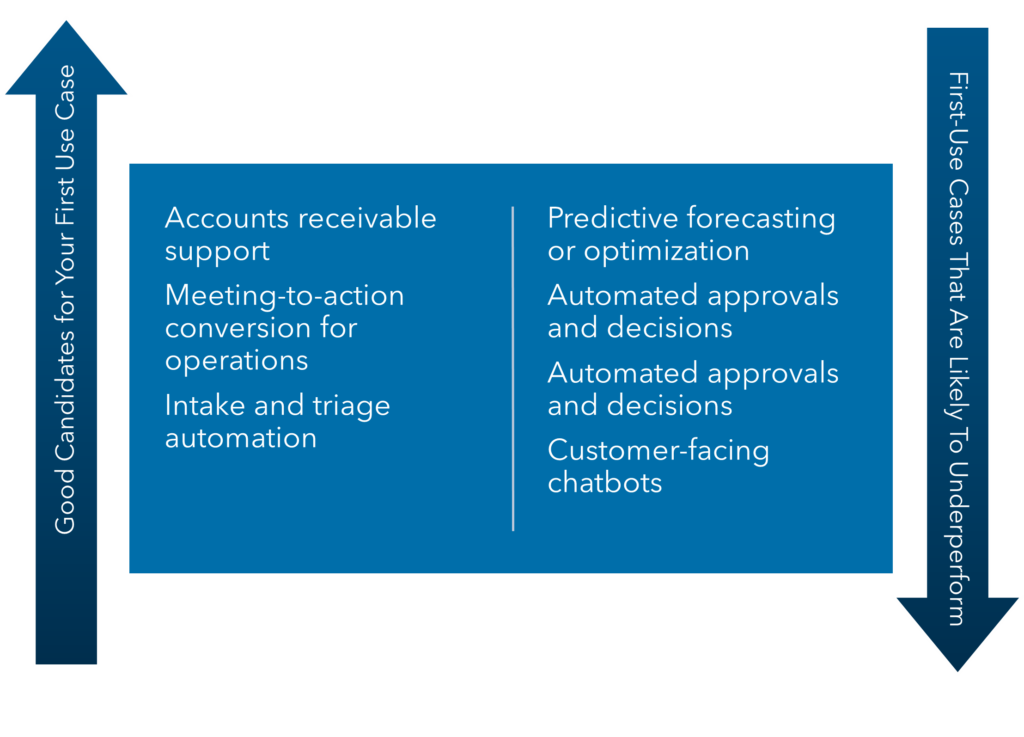
By this point, weak candidates should have been eliminated. Now you need to compare remaining ideas to select the strongest candidate. Give special attention to the tangible value the AI project will bring to your company in terms of time savings, cost, risk reduction and efficiency.
The output of this step is a single, defensible use case with one clear owner, one primary metric and defined guardrails.
Moving Forward With a Disciplined Approach To AI Project Selection
When AI efforts are planned and applied well, they can lead to immense value for your organization. You can save time, reduce errors and create impactful efficiencies. But, if they are not prepared and executed correctly, AI efforts also have the potential to hurt more than they help.
Choosing the right project is key.
If you’re not sure where to start, or if you’ve already tried a pilot that didn’t land the way you hoped, the advisors at Warren Averett Technology Group can help you work through this process with your specific workflows and team in mind. Connect with a WATG advisor to get help identifying your strongest first AI use case and build a roadmap grounded in real operational results
