
Understanding Your Business Exit Options

Many conversations about business transitions focus on a full sale, but a transaction does not always require a complete exit. Business owners considering a transition have several options available that involve different levels of ownership, control, liquidity, future upside and ongoing involvement in the business.
Ownership can change gradually or all at once. Control can be retained or transferred. An owner can remain involved in the business or step away over time. A transaction can include retained equity, outside capital or a complete sale.
The decision should come down to which option best aligns with your goals, your timeline, the right partner and what you want life after the transaction to look like.
Start by Narrowing Your Exit Options
Several factors can influence which transaction structures are worth considering. Before evaluating specific options, it helps to define what you want from the transaction and what kind of partner may be best positioned to help you reach those goals.
Defining Your Own Exit Goals
Some owners want to remain involved in operations, while others want to transfer control but retain an ownership position. Others are looking for a complete transition. Before comparing transaction structures, narrow the field by asking:
- How much liquidity do you want or need from the transaction?
- How important is it for you to retain control over major decisions?
- Do you want to continue participating in the company’s future growth?
- What role do you want to have in the business after closing?
- Do you want ownership to remain inside the family, transition to management or move to an outside party?
- What kind of partner, resources or expertise would help the company reach its next stage?
- How will different transaction structures affect your after-tax proceeds?
The answers to these questions will affect your available options just as much as the valuation or transaction terms.
Choosing the Right Partner Can Affect Your Options
The type of buyer or capital partner can influence how a transaction is structured, but it does not always determine whether the transaction is minority, majority or full. Many buyer types may consider more than one structure depending on their investment objectives, the company’s needs and the seller’s goals.
Private equity buyers typically invest through dedicated funds and work within a set investment strategy and holding period. Family offices generally invest their own capital and may hold investments for longer periods. Independent sponsors raise capital on a deal-by-deal basis, while search fund buyers are often looking for a single business they can acquire and operate.
Owners who want to retain an ownership interest after closing should consider the fit of the partner over the label of the buyer. Different partners may bring different expectations around governance, growth strategy, timing, capital needs and the owner’s ongoing role in the business.
Common Exit Options to Consider
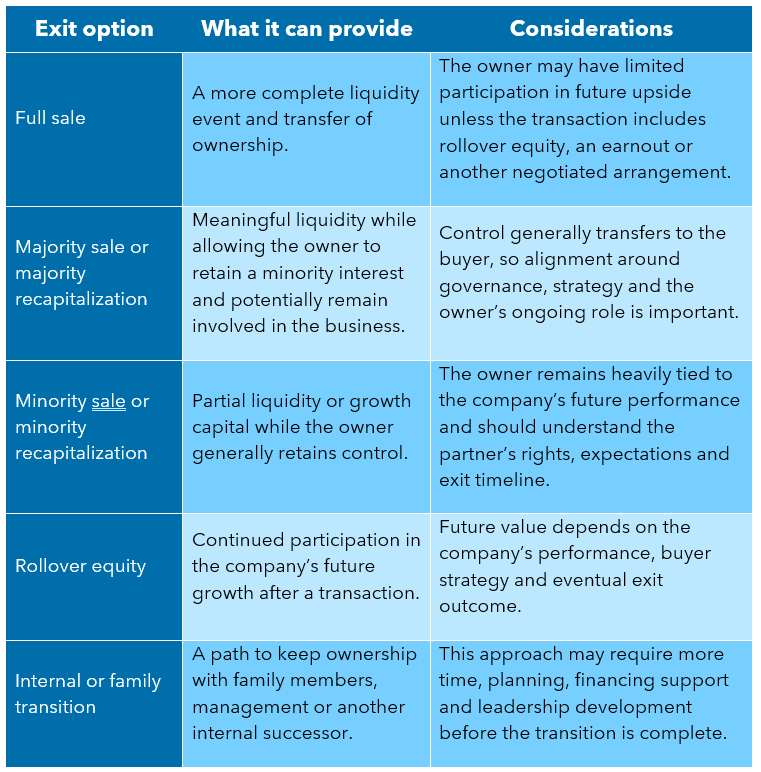
Exit planning is rarely a one-size-fits-all decision. The options below can help owners compare how different structures may affect liquidity, control, future upside and involvement after closing.
Tax Readiness Can Shape the Outcome
The way a transaction is structured, the condition of your tax profile and the timing of tax planning can all affect how much cash you keep after closing.
Before going to market, owners should take time to identify tax issues a buyer may uncover during diligence. That may include state filing obligations, sales and use tax exposure, payroll tax matters, worker classification concerns or other state and federal issues that could create surprises during a transaction.
Businesses operating in multiple states may benefit from confirming that the business is filing in the right jurisdictions based on where it has meaningful sales, payroll, property or other activity. Sales and use tax can be especially important because a hidden liability may affect purchase price, negotiations or closing certainty.
Some issues can be addressed before a buyer raises them. For example, certain state tax matters may be handled through voluntary disclosure programs, which can help limit the lookback period and reduce potential penalties or interest.
Transaction Structures to Know
Once you have defined your goals and you understand your buyer, you can evaluate different transaction structures based on the level of ownership, control, liquidity, tax impact and involvement they provide after closing.
Deal structure can have a significant effect on the proceeds available to the seller. Debt, transaction costs, tax treatment, purchase price allocation and cash at closing all affect the amount an owner ultimately receives.
Tax outcomes can also vary based on the entity structure and how the transaction is structured. The difference between a stock sale and an asset sale can be substantial.
Modeling after-tax proceeds before moving forward can provide a clearer view of how each option aligns with the owner’s financial goals.
Selling a Minority Interest
A minority recapitalization involves selling less than 50% of the business while retaining majority control. The owner receives liquidity but remains the controlling shareholder.
This structure can appeal to owners who want access to capital or a new investment partner while continuing to lead the company. In a minority recapitalization, ownership changes, but generally control remains largely in the same place.
Minority investments are among the transaction structures seen most frequently in today’s market. They can provide liquidity without requiring the owner to transfer control of the business.
Selling a Majority Interest
A majority recapitalization transfers control of the business to another owner while allowing the seller to retain a minority stake. These deals commonly include continued involvement from the owner after closing.
While control transfers to the buyer, the owner may continue working in the business and retain an ownership interest after the transaction. The discussion often centers on what that role will look like going forward.
Retaining Ownership Through Rollover Equity
Many majority transactions include rollover equity, but instead of transferring the entire ownership position into cash, the seller retains a portion of their ownership in the business after closing. Transactions may include the owner retaining 20% to 30% ownership through rollover equity.
This structure allows the owner to receive liquidity from the transaction while continuing to hold an equity interest in the business. If the company is sold again in the future, the owner’s retained equity can participate in that transaction as well.
Rollover equity may also offer a potential tax-deferral benefit on the portion of the purchase price exchanged for buyer equity, depending on the transaction structure and applicable requirements. That can allow a seller to receive cash at closing while preserving the possibility of future upside if the business is sold again later.
Certain owners may also benefit from evaluating specialized planning opportunities, such as Qualified Small Business Stock treatment under Section 1202, early in the process. Because these opportunities depend on specific facts and timing, it’s best to consider them before transaction terms are finalized.
Exit Options Don’t Have to Be Permanent End States
A minority recapitalization, majority recapitalization, rollover equity arrangement or staged internal transition is often one step in a broader ownership transition instead of a final outcome.
Ownership, control and involvement can continue to change after the initial transaction is complete and they don’t even have to change at the same rate. (A transaction may transfer control, leave an ownership interest in place or create an opportunity for additional liquidity in the future.)
So, for owners considering their next step, the transaction does not always define the end state. It may simply define the next stage of ownership.
To learn more about setting your business up for a transaction, modeling your after-tax proceeds or evaluating which exit options may be the best fit for your goals, contact your Warren Averett advisor directly or ask a member of our team to reach out to you.
