
From Considering a Sale To Being Exit Ready: What Happens in Between?

A business sale is a very important decision—probably the most important in the life cycle of entrepreneurship.
It takes months, and sometimes years, of planning to ensure a successful outcome. While the journey can be long and tedious, it can also be quite rewarding for all involved, including the business’s owners, stakeholders, families and employees.
Transaction planning might start when growth and complexity of the business feel overwhelming, or possibly when capital constraints present themselves, or when existing systems and processes begin to break down. Or it might just start when the owner’s personal priorities begin to shift.
When scenarios such as these occur, selling often becomes a practical idea that an owner keeps in view while he or she keeps running the business to the best of his or her ability. This stage can stay open-ended for a long time before the business is actually ready for a transaction.
The in-between stage is when optionality shrinks.
To truly shift between “thinking about selling” and being “exit ready,” the business needs to stand on documented results, repeatable operations and a leadership structure that works without constant owner intervention. That’s what separates a company that can move on its own timeline from one that ends up reacting to someone else’s.
The “Thinking About Selling” Stage
Many owners start thinking about selling because of retirement and succession planning, burnout, market conditions, family considerations or plain curiosity.
While it’s normal to want a valuation before deciding to sell, owners in this stage tend to treat a valuation as an information exercise. Owners want a number, but the business hasn’t been examined the way a buyer would. Issues within the business feel manageable because they can be explained. Growth can feel close because more time, more capital or one more hire could unlock it.
Those explanations make sense internally, but they won’t hold up once diligence starts.
Attention in the “thinking” stage also stays on the transaction itself instead of the realities tied to a sale. Once selling feels possible, decision making often slows. Owners begin to question if they should do things like hire a senior leader or replace equipment now, or if they should leave it for a buyer to handle. Taxes, timing, family dynamics and what life looks like afterward are still unresolved.
But for businesses and owners that stay in the “thinking” mode over a long period of time, that hesitation leaves the business less invested in and less prepared, even if it’s closer to a transaction than it was before.
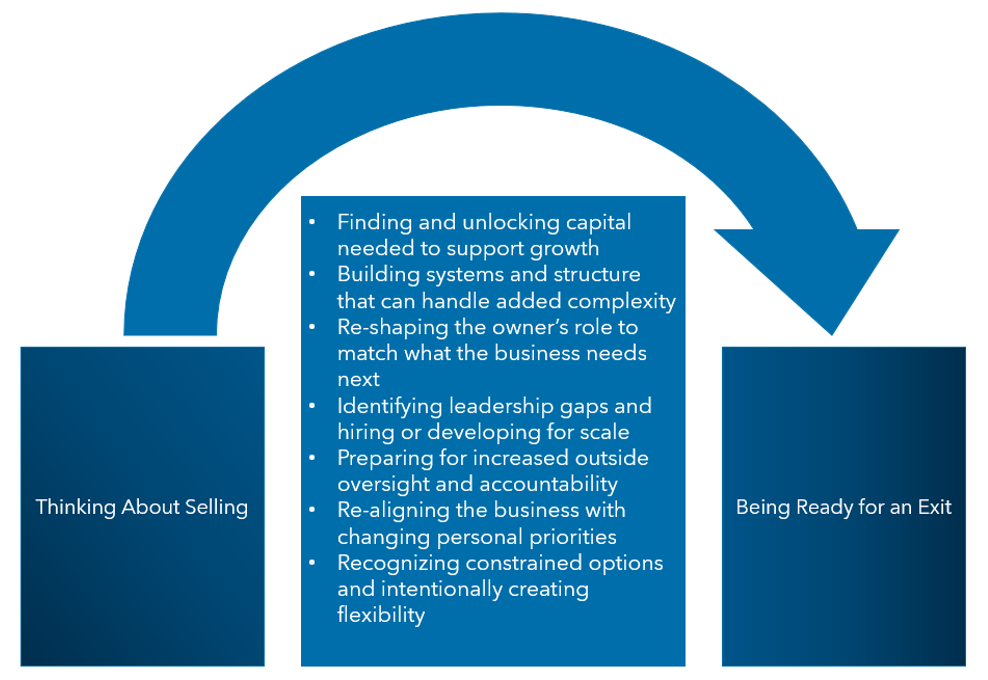
Moving From “Thinking” Stage to “Exit-Ready” Stage
Thinking about selling is part of the process. Treating that mindset as readiness is what creates risk. Thinking mode gathers information. Exit-ready mode holds up under scrutiny. There are a few intentional ways to deliberately make that shift.
Talk With an Investment Banker
A valuation conversation with an investment banker or broker who specializes in your industry and business size will help. (These conversations are intended to stay confidential but be certain to sign a nondisclosure agreement prior to sharing any information.)
The intention is to reframe the valuation around buyer expectations instead of owner assumptions. This process surfaces how the business is likely to be viewed, what terms are realistic and where value is likely to be discounted or supported.
Strong bankers highlight likely deal terms, realistic pricing ranges and the issues that will shape outcomes. Speaking with more than one banker often sharpens that picture and can show how different buyer pools may view your business.
These conversations also clarify value drivers and value detractors. Some issues can be fixed. Others need to be managed or explained. Knowing which is which helps owners decide whether to move forward, delay or invest more time, money and/or effort in the business before going to market.
Conduct an Exit Readiness Assessment
An exit readiness assessment translates insight into action and can set you up early to avoid common mistakes that could jeopardize the sale. While frameworks vary, effective assessments focus on what increases confidence and what introduces doubt.
In our approach, that review typically spans eight pillars:
- Legal
- Financial
- Sales
- Marketing
- Leadership
- People
- Planning
- Operations
When the assessment is done correctly, owners see where the business stands today and what changes are likely to improve outcomes within a realistic timeframe.
Understand Your Options
Exit readiness also includes understanding the full range of exit options and how each one aligns with your personal and financial goals. Different paths have different control, timing and proceeds. Further, after-tax results are often materially different than expected without detailed modeling.
The “Exit-Ready” Stage
Exit-ready companies continue to operate for the long term and make key strategic and investment decisions regardless of a transaction, especially if those decisions may reduce risk during the transition period. (Buyers generally respond well to that discipline.)
Exit readiness shows up in how prepared the owners are when diligence begins.
Business Exit Readiness
Operationally, exit-ready businesses can be examined at any time without a scramble to prepare. Decisions follow a methodical process. Investments support the way the business actually operates and how it could operate after ownership changes. Culture, performance and staffing remain steady.
Continuity is visible, customer and vendor relationships are distributed, and the business does not rely on a single person. Core functions are covered by a management team who can function without constant owner intervention.
That operational stability has to hold up financially and legally.
Financial readiness
- Reporting reflects how leadership runs the business
- Key performance indicators are relevant, timely and consistently used
- Personal expenses and one‑time items are eliminated or clearly identified and supported
- Financials are aligned with GAAP expectations
- Audit history, findings and resolutions are clearly understood
Legal and compliance readiness
- Ownership structure is documented and current
- Customer, vendor and employee agreements are in place
- Open claims, warranties and disputes are identified and mitigated
- Informal arrangements have been formalized
- Verbal agreements, including early-stage promises around ownership or roles, have been addressed
- Compliance obligations across safety, regulatory, industry-specific or healthcare-related requirements are current and supported
Processes and procedures reduce transition risk. Routine work is documented. Teams are cross-trained. Knowledge doesn’t live in one person’s head. Buyers want confidence that the business will operate smoothly after closing, not just at signing. A buyer doesn’t want a situation where tribal knowledge walks out the door on day 1 or day 90.
The same applies to your cybersecurity posture. Having a technology/cybersecurity risk assessment can identify risks and vulnerabilities throughout the network. This helps buyers gain comfort that potential issues have been uncovered, communicated and strategized.
Decision making is also a signal of readiness. Exit-ready owners continue to hire when roles are necessary and upgrade assets when replacements are due. They make choices based on what the business needs to perform well, not on what a buyer might prefer or to defer costs onto the next owner.
Owners also think carefully about who is included in deal discussions. The circle is tight but intentional. Key leaders are protected from surprises, and unnecessary noise is avoided. A wider circle increases the chance that employees or the broader market hear about a possible deal before anything is certain. A circle that’s too tight can develop trust and retention issues with critical leaders.
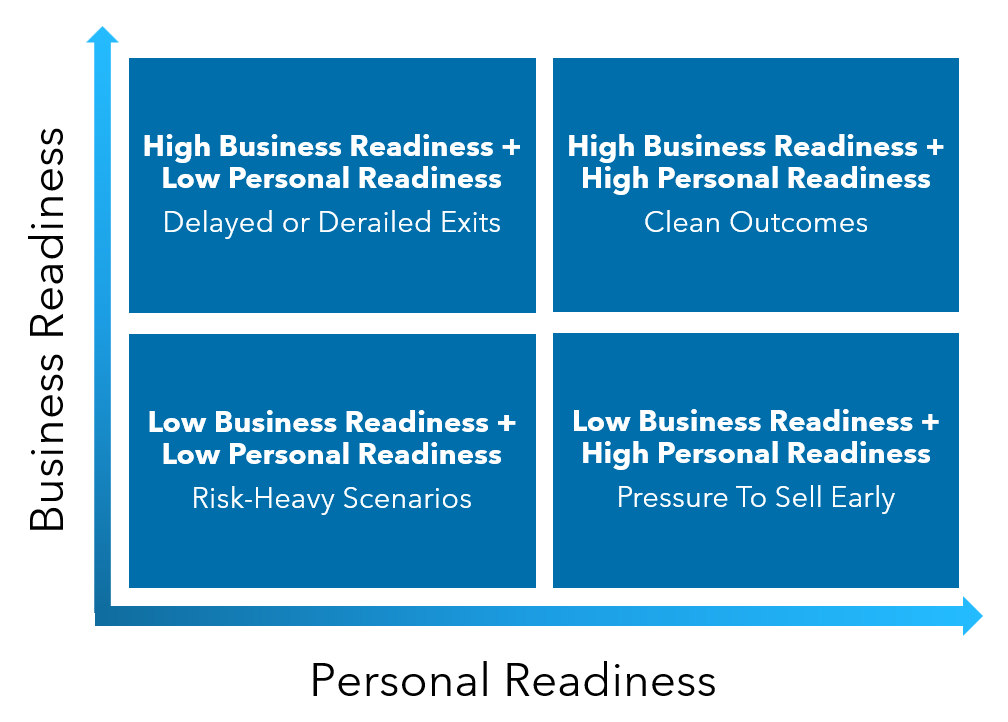
Personal Exit Readiness
An owner’s personal readiness is just as important. A business can perform well and still struggle through a transaction when the ownership group is unprepared for the realities of a sale. That preparation includes understanding viable exit paths and modeling taxes based on actual after-tax outcomes rather than rough estimates.
Estate planning, wealth planning and generational planning address different risks and have been given separate attention. Personal dynamics can influence timing and structure, especially in multi-generation businesses or when family members work in the company. Aligned personal plans lead to less pressure later.
Owners also benefit from planning what comes next after an exit. A sale changes daily structure and identity. Having a clear next chapter, beyond a short break to travel and play golf, helps avoid regret and second-guessing after the deal closes. All too often, business owners who haven’t fully developed their plans after a transaction underestimate how much post‑sale structure and clarity factor into long‑term satisfaction.
Learn More About Becoming Exit Ready
Becoming exit ready happens over time, not all at once. It’s the result of choices made while the business is still being run with a long-term mindset and before a transaction introduces pressure. Owners who address readiness early tend to have more control over timing, more flexibility in structure and fewer compromises when discussions move forward.
Discussing those considerations with an advisor can also help determine how close the business is to being ready, and what steps, if any, would meaningfully improve outcomes. (See our due diligence checklist here.)
To learn more about moving your business from “thinking” mode to “ready” mode, contact your Warren Averett advisor directly, or ask a member of our team to reach out to you.
