
How CMMC Compliance Is Reshaping Defense Supply Chains

The final 48 CFR rule, which was published in the Federal Register on September 10, 2025, makes Cybersecurity Maturity Model Certification (CMMC) compliance a condition of contract eligibility if your business handles Federal Contract Information (FCI) or Controlled Unclassified Information (CUI) for defense work.
And, on November 10, 2025, the Department of Defense officially began enforcing CMMC requirements in new contracts.
This long-awaited standard affects every organization in the defense supply chain, from the largest prime contractors down to the smallest subcontractors. So, regardless of your specific organization, understanding your obligations under this new rule is essential to protecting your business.
What CMMC Means for Prime Contractors
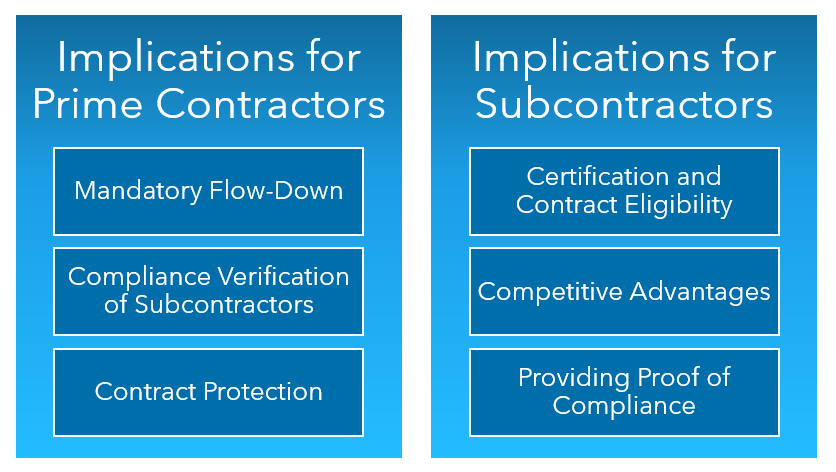
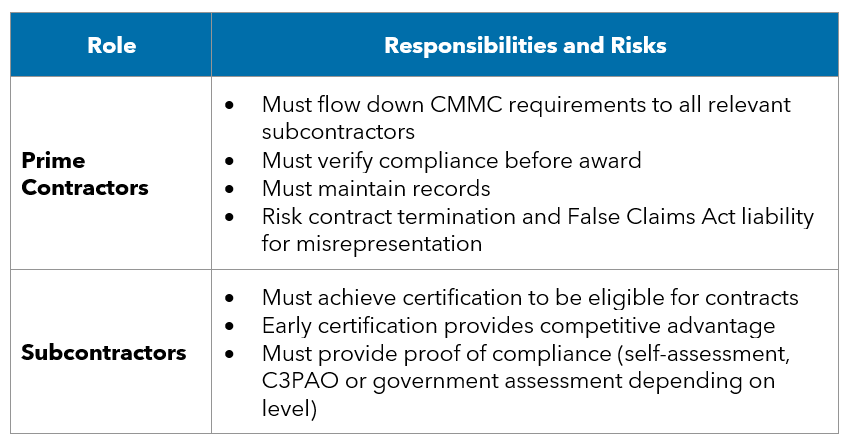
Prime contractors must include specific CMMC language in every subcontract where sensitive information will be handled. CMMC requirements flow down to all subcontractors who process, store or transmit FCI or CUI, ensuring consistent cybersecurity standards across the entire supply chain. All contracts should clearly specify the required CMMC level.
Be sure to consider the sensitivity of the information being shared when specifying the CMMC certification level. Build in requirements for subcontractors to maintain compliance throughout performance and notify you immediately if their status changes.
Your organization should use formal processes to verify that subcontractors have the required CMMC certification before awarding subcontracts. This includes checking the official DoD systems where CMMC certifications are registered and requesting and reviewing certification documentation.
Non-compliant subcontractors cannot be awarded work. Awarding work to a subcontractor who lacks proper certification can place your prime contract at risk.
It’s also necessary to maintain records that demonstrate due diligence in your vetting process. To help mitigate delays in the procurement process, you may want to require potential subcontractors to demonstrate CMMC compliance before they’re even considered for work.
The government can terminate contracts for non-compliance, and if compliance is misrepresented, your organization could face serious consequences under the False Claims Act. To limit risk, develop contingency plans, such as maintaining a list of CMMC-compliant subcontractor alternates in case a preferred subcontractor fails to certify in time.
Your internal teams should also understand the CMMC framework and their specific roles related to compliance verification. Ideally, training should be as role-based as possible. For example, your procurement team should know how to properly verify CMMC compliance, while your legal team should be briefed on potential False Claims Act exposure.
The Impact of CMMC on Subcontractors
For subcontractors, CMMC compliance now determines your eligibility to compete. Without the proper certification, you’re excluded from defense contracts entirely.
While many subcontractors are still figuring out their compliance strategy, early certification can set you apart and make you an attractive option to prime contractors. This demonstrates that your organization has a cybersecurity maturity that extends beyond basic requirements and positions your organization as a lower-risk partner, compared to other subcontractors.
Budget realistically for both the assessment costs and the security improvements you’ll need to implement beforehand. The costs vary significantly based on multiple factors, such as the CMMC level you’re targeting and your current security posture.
The level of the certification you need also impacts the timeline, and many organizations need as long as a year to prepare for an assessment. Start now so that you’ll already be certified when opportunities arise.
Prime contractors will expect proof of your certification:
- Level 1: You need to provide your self-assessment scores and senior official attestation.
- Level 2: You must provide your verification of compliance. Based on the critical nature of your CUI, this could be a self-assessment or provided by a C3PAO.
- Level 3: You should provide government-led assessment results for the most sensitive programs.
Also, your Supplier Performance Risk System, or SPRS, score serves as the DoD’s official verification of your compliance status and is what contracting officers check before awarding contracts.
Start with an honest assessment of your current security posture against CMMC requirements and identify the controls that need implementation or improvement. You should then develop and document the policies and procedures required for certification.
Proactively communicate with your prime contractor customers, reinforcing your compliance efforts as protecting their contracts and reducing their risks. This entails keeping them informed about where you stand in the certification process and sharing milestone updates and providing copies of relevant documentation as you progress. Be transparent about any setbacks or obstacles you encounter.
You may also consider whether collaborating with other subcontractors could make compliance more affordable through shared resources. You can ask your prime contractor customers if they offer any support programs for critical suppliers. There are also managed security service providers who specialize in CMMC requirements.
Strategic Shifts in the Defense Supply Chain
Beyond the immediate organizational impacts of mandatory CMMC compliance, both prime contractors and subcontractors should expect a fundamental shift in how the defense supply chain operates.
Because prime contractors now have to reassess their supplier networks, organizations that cannot or will not achieve CMMC certification are being filtered out, even if they have been reliable partners for years. From the prime contractor’s perspective, the risk of working with non-compliant subcontractors is simply too high.
Compliant businesses are gaining significant leverage over those who are unable to get certified. If you’re certified and your competitors aren’t, you’re suddenly in a much stronger position to be awarded contracts. However, along with this comes increased pressure to maintain compliance, since losing your certification could mean losing multiple contracts simultaneously.
Some smaller subcontractors are also forming teaming agreements to share compliance costs and resources. For example, organizations specializing in handling CUI may allow other partners to focus on non-sensitive work that requires only Level 1 certification. This new dynamic may additionally reshape the market.

Get Expert Guidance on Your CMMC Compliance
Navigating CMMC requirements requires expertise in both cybersecurity and defense contracting regulations. Warren Averett Technology Group understands both the technical requirements and the practical realities. Speak with a WATG cybersecurity advisor today about your CMMC compliance strategy.
