
Are Your Organization’s Events Attracting Hackers?
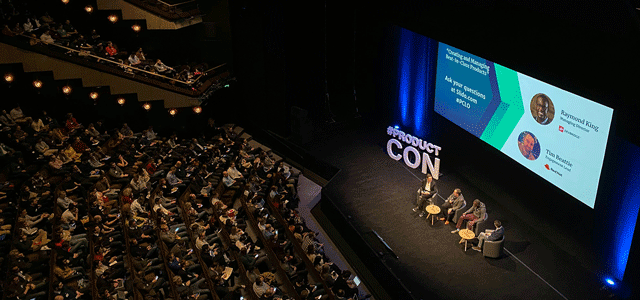
Coordinating an event for your business rarely happens in a neat, linear way.
While one person is finalizing hotel details, another is confirming speakers. Vendor invoices are coming in. Registration questions are piling up. Confirmation emails are going out. Changes are being made in real time.
In that kind of environment, messages start flying. Many come from people you know. Others come from systems you recognize. And some come from contacts you’ve never met before.
Many of them look routine and time sensitive, and they often need a quick response so the event planning can keep moving. But that’s also where mistakes can happen that open your business up to cybersecurity threats.
Here, we’ll look at why corporate events have become such a common cyber target, how these attacks typically show up, and practical ways to protect your business without slowing everything to a halt.
Why Are Hackers Targeting Corporate Events?
Businesses are prime targets for cyberattacks in general simply because they move money and information every day. Those two factors provide hackers with opportunities to get paid, collect useful information, or gain access to your systems without immediately raising suspicion.
Corporate events certainly aren’t the only time this happens in businesses, but it’s becoming more common for a few distinct reasons that, when combined, create an environment for deception to thrive:
- Event planning creates a surge of legitimate business communications that are familiar and expected.
- Events bring more people (inside and outside of your organization) into the process. Vendors, speakers, venues and internal teams are all coordinating at the same time, often across different systems.
- The business doesn’t stop just because an even is being planned. Corporate event coordination usually happens in addition to a business’s normal operations, and many team members take on additional event-related responsibilities on top of their typical roles. Especially in lean teams, this can create an element of distraction to even the most cyber savvy employee.
- Conferences have rebounded in full force after the pandemic. More activity is happening now than in years past. People are more comfortable and more excited to participate in events, which can create a false sense of security.
How These Attacks Show up in Corporate Events
Cyberattacks can show up around events of all types and sizes, but many attacks commonly arrive as phishing attempts (when a hacker poses as a legitimate organization through email or text to get you to click a link, share information or send payment).
Phishing messages tied to an event typically arrive as emails or texts that reference real event activity. They may claim to come from the venue, the event organizer, a speaker or a vendor connected to the event. The message usually aligns with something already in motion, such as registration details, vendor coordination or logistics, which is why it can be easy to treat it as legitimate at first glance.
Aside from threats to the hosting organization, it’s also common for hackers to target an event’s vendors. For example, a message to your vendor may claim to be from your conference and provide instructions for securing a vendor table, or it may say that a confirmation was not received. It reads like a routine request, the timing fits what vendors expect during planning, and it looks like a typical conference communication, but it’s coming from somewhere else.
When someone acts on a phishing attempt like this (usually by clicking on a malicious link in the hacker’s message), network access can be granted to someone with poor intent, and money can be sent where it shouldn’t be.
Protecting Your Business’s Event from Phishing
The most important thing you and your team can do to protect your business from phishing attacks is to never rely on the contact information inside the message itself, even when the message looks legitimate.
If a message claims to be from your bank, use the phone number on the back of your card. If it claims to be from an event, hotel or vendor, go directly to the official website and use the contact information listed there. The key is that you choose the source, not the message.
That extra step can feel inconvenient, especially when you’re trying to keep things moving. In practice, it’s often the difference between confirming a routine detail and dealing with a payment or issue that didn’t need to happen at all.
Many large events post reminders about phishing, but event‑related phishing keeps working, because hackers don’t stop after one attempt. When one message doesn’t get a response, another follows. The name may change. The wording may shift slightly. The claim stays the same.
The safest habit is to pause and confirm using a source you already trust.
Learn More About Protecting Your Organization From Cyber Threats
Event planning already comes with enough moving parts. The last thing you need is a cyberattack on your hands too.
A few simple verification habits can prevent avoidable payment issues and time-consuming cleanup. If you want a second set of eyes on what your team is seeing, or if you want to talk through how to reduce event-related risk without slowing down operations, contact your Warren Averett Technology group advisor, or ask our team to reach out to you.
