
How Gaps in IT Leadership Quietly Shrink Your C-Suite’s Bandwidth

Many executives deal with daily IT disruptions that disguise themselves as urgent.
Nothing is technically “down,” but there may be a request for a new tool that someone wants today. Or maybe someone needs an access exception that can’t wait. Or maybe there’s a vendor handoff that will remain on hold until a someone with senior standing weighs in.
IT keeps showing up on the C-suite’s calendar, but most of the time, it isn’t for strategy. It’s for approvals. Taken alone, each one of these instances is easy to dismiss. Together, they add up to a steady drain on your and other executives’ time and attention.
When this pattern becomes the norm, the problem usually isn’t the technology itself, but a gap in IT leadership.
What “IT Leadership” Actually Means
IT leadership is often misunderstood as a staffing subject, but it’s actually an operational one that isn’t necessarily grounded in titles or organizational charts.
You can have a fully staffed internal IT team and still have an IT leadership gap. You can also have a lean, scrappy IT operation and have strong IT leadership. The difference is about how the decisions are made and enforced.
True IT leadership means clarity and accountability in four areas:
- Decision rights – Who is authorized to approve or deny an access exception, a tool purchase or a security tradeoff?
- Prioritization – How is IT work sequenced, and who protects it from constant reshuffling when something urgent arises?
- Standards – What does normal look like for devices, access levels, backups and patching?
- Enforcement – What happens when someone bypasses the standard? Who is accountable or owns outcomes across internal staff and external vendors?
If the answers to these questions are unclear, decisions will default upward. And without a defined standard, your IT team has no reference point, so even the most routine questions will likely have to be answered by an executive.
Why IT Leadership Gaps Show Up as Companies Grow
Gaps in IT leadership often occur during company growth because, as your company grows, you naturally add complexity to your organization, and you outgrow the informal decisions and processes that worked when the company was smaller.
Every new platform your business adopts connects to something else. And with each connection, new decision points are created, including who has access, how data moves, etc. Without consistent standards governing those decisions, the small inconsistencies can go unnoticed until they’ve already caused a problem.
Company growth also means more users and locations, which creates variance unless standards are actively enforced. When there’s no enforced baseline for how devices are configured, how access is granted or how data is handled, each new employee, contractor or office location develops their own informal practices.
If this occurs long enough, it creates cybersecurity gaps, compliance exposure and operational inconsistency that grows harder to unwind the longer it goes unaddressed.
How To Tell if You’re Dealing With Normal Growth Friction or an IT Leadership Gap
Many of these conditions occur naturally in a growing business, and they are not necessarily a direct indication that something is wrong.
Not every period of IT turbulence signals an IT leadership problem. There are certain events, such as a major migration, an acquisition, a new office opening or rapid hiring, that will create short-term chaos, which is to be expected. Here’s how to tell the difference between normal growth friction that will resolve with time and an IT leadership gap that must be addressed:
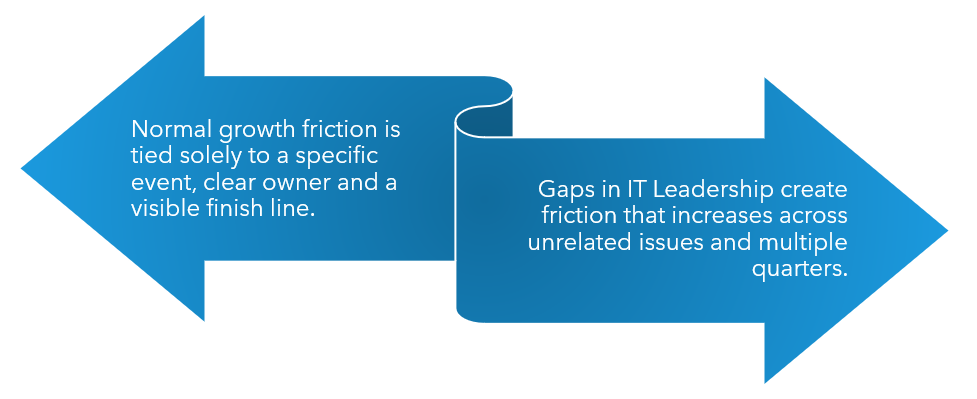
Normal Growth Friction
Normal growth friction is tied solely to a specific event. As that event resolves, such as a new system going live during a migration, the growth friction decreases in intensity. Even when execution of the event gets messy, there’s a clear owner and a visible finish line.
IT Leadership Gap
A gap in IT leadership is noticeably different. Instead of being linked to a single event and resolving when that event ends, it repeats across unrelated issues and multiple quarters. Executive involvement will increase over time because more decisions lack clear owners, more exceptions accumulate without resolution and decisions that were supposedly already made get reopened. Essentially, the IT friction is intensifying rather than resolving.
Six Signals That an IT Leadership Gap Is Draining Your C-Suite
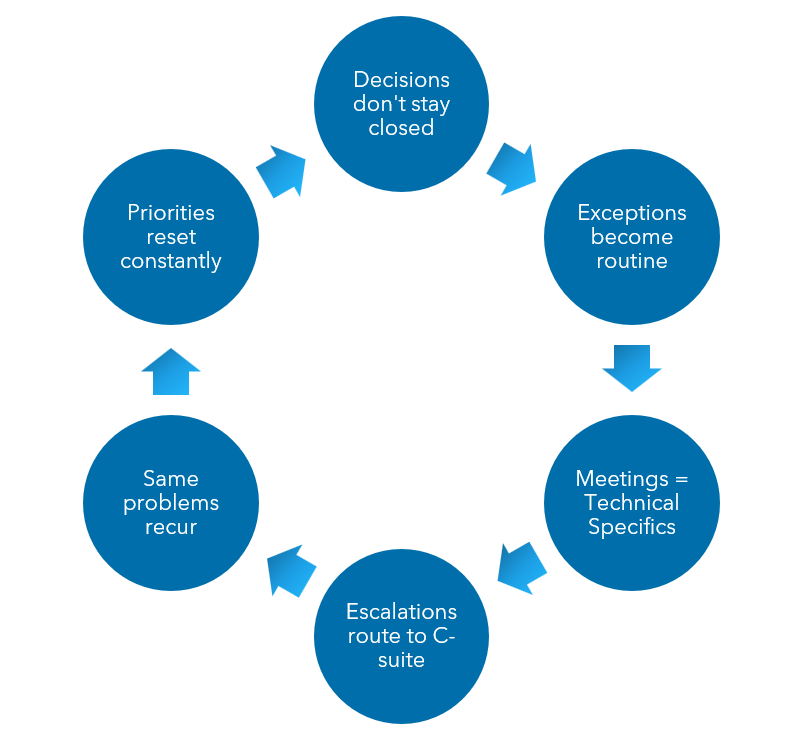
You may already feel a gap in IT leadership before you label it. These six signs can help you confirm that attention is needed in this area:
1. Decisions don’t stay closed.
The same access requests and tool questions keep resurfacing for re-approval. This is a sign that decision rights are unclear and there’s no enforceable default in place.
2. Exceptions become routine.
Without a defined exception process and real enforcement, one-off approvals create downstream inconsistencies that generate new escalations.
3. Meetings drift into implementation detail.
You find yourself in discussions about technical specifics that don’t belong in a leadership meeting. This happens when there’s no designated decision owner presenting options with clear tradeoffs.
4. Escalations route to the C-suite for routine approvals.
If your team has no escalation path that resolves below your level, work pauses until you respond. You’ve become the default bottleneck because the process leaves no alternative.
5. The same problems recur in slightly different forms.
When the root cause is never addressed, the problem resurfaces with repeat escalations and explanations.
6. Priorities reset constantly.
When there’s no protected prioritization mechanism, everything becomes urgent. Planned work stalls, rework accumulates and leadership gets pulled in to re-align and restart repeatedly.
How To Establish IT Leadership and Reclaim Your Calendar
To establish true IT leadership in your organization, start by identifying the decision types that tend to repeat, such as access exceptions, tool approvals, priority conflicts, etc., and assign clear ownership. Once the decisions have owners, they stop defaulting to the C-suite.
Then, define what “standard” looks like for approved tools, device configurations, file sharing and access credentials. When your IT team can reference a documented default, routine requests stop turning into meeting detours and you’ll see faster decisions.
Even though you can’t prevent every exception, every exception should follow a process. Define what qualifies as an exception, what information is required to request one and how long approvals are valid. This keeps one-offs from becoming permanent policy.
Decide in advance how interruptions are handled, who breaks ties and what gets paused when something urgent arrives. When that process exists and is followed, you stop spending leadership cycles re-deciding what gets dropped.
Whether you have internal staff, a managed service provider or a mix of vendors, one person should own the outcomes from end to end, including what “done” means so that “not our scope” loops resolve before they reach leadership. There will be less arbitration moments and status churn meetings to unblock progress.
Eliminate Your IT Leadership Gaps
To address an IT leadership gap, you must ask the right questions: Where do decision rights actually live today? How are priorities set and protected? Where do standards break down in practice? Why do escalations default to the C-suite?
For some organizations, that assessment leads to internal realignment. For others, it reveals the need for an external partner to own and operate those leadership mechanics daily, so the business can keep growing without that growth continuously landing on their executives’ calendars.
Connect with an experienced Warren Averett Technology Group advisor to assess where your IT leadership gaps are and what it would take to close them.
