
SECURE 2.0 in 2026: Does Your Company’s Retirement Plan Document Match Plan Operations?

For three years, retirement plan sponsors have operated under a kind of regulatory grace period. SECURE Act 2.0 provisions took effect operationally before formal plan amendments caught up, and the Internal Revenue Service (IRS) allowed “good faith” compliance to close that distance. That grace period ends on December 31, 2026.
After this date, your written plan document and your plan operations must be consistent.
For businesses that sponsor a 401(k) or similar defined contribution plan, a mismatch between the plan document and operations constitutes a qualification failure. This could lead to disqualification of the plan, IRS sanctions and a breach of fiduciary duty under ERISA. These failures put the plan’s tax-favored status at risk for every participant, not just the owner.
One question should drive everything you do as a plan sponsor this year: Does your plan document reflect how your plan actually operates?
Many sponsors have already implemented SECURE 2.0 changes operationally through their recordkeeper, payroll provider or third-party administrator (TPA), without realizing they never formally amended the underlying plan document to match. But the time has come when the paperwork must match reality.
To be sure your company’s retirement plan is compliant, follow these four steps before the end of the year.
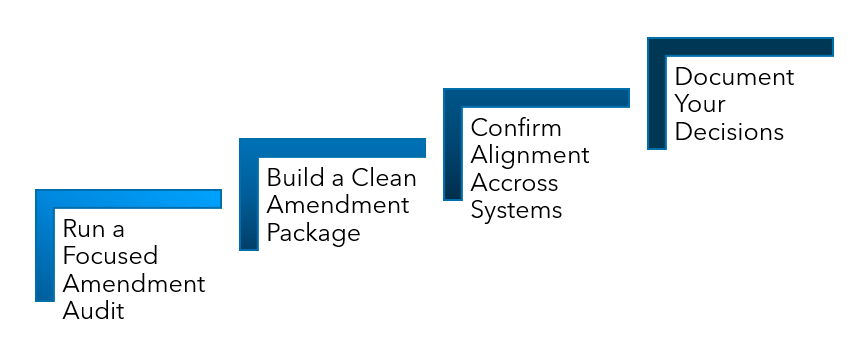
Step 1: Run a Focused Amendment Audit
First, identify any gaps between what your document says and what your plan does. The following four areas carry the most risk.
- Distribution rules – Confirm you have updated the required minimum distribution (RMD) age to 73 in both the document and in practice, the plan document reflects the elimination of RMDs for Roth employer accounts, and it references the updated penalty framework for missed RMDs.
- Eligibility rules – Confirm the plan permits long-term part-time employees to participate once they meet the service requirement, and that your methodology for tracking hours aligns with the 500-hour standard.
- Contribution rules – Confirm the company processes catch-up contributions under current rules, and you have a process for identifying high earners for mandatory Roth catch-up treatment.
- Operational defaults – Confirm the plan document reflects recordkeeper-applied features like auto-enrollment or distribution timing defaults. “Silent” updates your provider implemented on your behalf are a common blind spot.
For example, say you are a manufacturing company with 45 employees. Your recordkeeper automatically began routing catch-up contributions for employees earning above the income threshold into Roth accounts last year. The plan document, last amended in 2023, still describes catch-up contributions as pre-tax only. Operationally, the company is compliant. On paper, it isn’t.
An amendment audit can catch this kind of discrepancy before your employee benefit plan auditor, the Department of Labor (DOL) or the IRS does.
Step 2: Build a Clean Amendment Package
Once you identify the shortfalls, the fix falls into three categories. Your advisor can help you determine which fits your scenario.
Required Provisions
Required provisions should already be operational. Examples include the increase in the RMD age to 73, the removal of the RMD requirement for Roth employer accounts, expanded eligibility for long-term part-time employees and the Roth catch-up requirement for high earners.
Optional Provisions
Optional provisions are where noncompliance tends to go unnoticed. Enhanced catch-up contributions for ages 60 to 63, Roth employer contributions, increased involuntary cash-out thresholds, and administrative simplifications offered by your provider all require an affirmative decision. If you use a feature, document it. If you don’t use it, that exclusion should be intentional and documented in writing.
Cleanup Of Outdated Language
Cleanup of outdated language addresses references to prior RMD thresholds, pre-SECURE eligibility standards, contribution language that no longer matches payroll processing, and legacy provisions carried forward through prior amendments. A clean amendment package should read as a current operating manual.
Step 3: Confirm Alignment Across Systems
A correct plan document doesn’t guarantee compliance. Your document, payroll system and recordkeeper’s operations must all tell the same story.
How do you identify high earners and route catch-up contributions to Roth accounts? How do you track eligibility for part-time employees? How does the company calculate and process distributions?
Most compliance failures originate here, in the operational handoff between systems, rather than in the document language itself.
Step 4: Document Your Decisions
The choices you make define your plan. In writing, be explicit about how you manage Roth catch-up implementation and payroll coordination, eligibility tracking methodology, distribution timing, participant communication and any reliance on recordkeeper defaults.
Documented decisions create consistency throughout your HR, payroll and finance teams, and they prevent costly rework when a new provider or auditor asks how you implemented a provision.
Learn More about Maintaining a Compliant Retirement Plan
By December 31, 2026, your plan document must reflect what you are already doing operationally.
Review your plan against these four steps now, while there’s still time to correct course. Being proactive is far less costly than discovering shortcomings during an IRS or DOL audit.
To learn more, contact your Warren Averett advisor to learn more, or ask a member of our team to reach out to you.
