
Business Continuity Plan: Steps to Create a Strategy

Natural disasters and cyber attacks can happen to any business. Would your business be prepared if it happened to you?
You can position your company to effectively weather potential disasters by establishing a business continuity plan—but more than half of companies worldwide don’t have one.
Creating a business continuity plan can feel overwhelming, especially if you’re starting from scratch, but there are certain business continuity plan steps that can help guide you through the process.
What is a Business Continuity Plan?
A business continuity plan outlines how you should respond to a sudden change and ensures that your organization has appropriate procedures in place in the event of a disruption or crisis. A business continuity plan will most often be associated with natural disasters, but it can also apply to many other potential events, like cyber attacks or bad publicity.
A well-balanced business continuity plan should focus both on recovery and preparation for these events so that your company is positioned to respond effectively.

Business Continuity Plan Steps
So, how do you make a business continuity plan?
While business continuity plan examples are available to help you get started, you’ll want to customize your plan for your specific business needs. We’ve outlined the minimum business continuity plan steps to follow to set you up for success in case of an emergency.
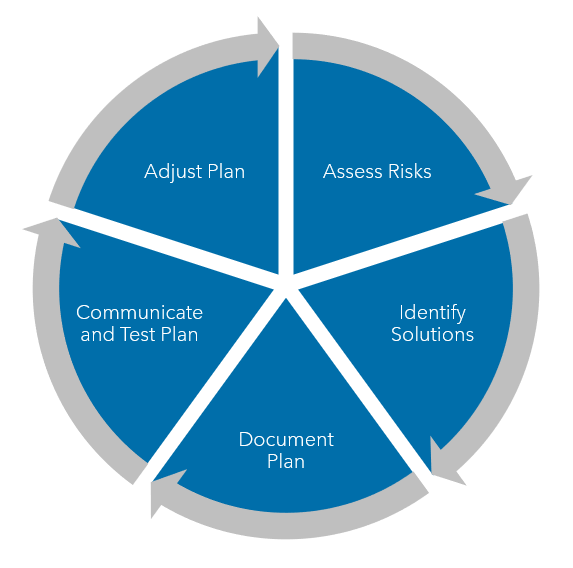
Business Continuity Plan Step One: Assess Risks
Identify Your Critical Functions
Start by identifying Critical Business Functions. Critical Business Functions (CBF) are the activities and processes that must be restored in the event of a disruption to protect company assets, satisfy regulations, and meet an organization’s most basic needs.
Assess Your Risks
It’s important to assess your unique company’s specific risks. These risks vary, and can include anything from environmental risks to data security risks, or even internal risk factors due to personnel turnover.
Analyze Risk Impact
Once you’ve identified the unique risk factors for your business, you’ll need to analyze the impact of those risks. At a minimum, you should analyze the risks to your company concerning data security, customer response, and employee safety.
Business Continuity Plan Step Two: Identify Solutions
Consider Your Data
Your customers trust you to keep their data safe. A business continuity plan is critical for maintaining trust in the event of a disaster. Significant data loss can cause the business to fail.
It’s your job to ensure that data is backed up, easy to recover, and accessible. Include your data backup process, your access options, and your recovery procedures for all your data in your business continuity plan.
Consider Communication
Crisis communication is essential for business continuity. When a crisis strikes, you need a plan to communicate with stakeholders, vendors, and other parties. Depending on the disaster your communication methods and tools may be limited, so consider ahead of time how you would connect with appropriate parties.
You’ll also want to provide the right amount of information to relevant parties—information about the severity of the problem, the impact on their service, and whom to contact for more.
Business Continuity Plan Step Three: Document Your Plan
A plan that isn’t documented can’t be followed, so one of the most crucial business continuity plan steps is to use the information you’ve gathered to create a thorough strategy. At a minimum, a business continuity plan should contain:
- The key team members of the organization and important external contacts;
- Identified communication methods;
- The essential daily activities that keep the company operating;
- The types of disasters the continuity plan covers;
- Details about recovery processes;
- The budget allocated for recovery efforts and a timeline to execute the recovery procedures;
- Procedures for reporting disruptions and escalations
- Procedures for data recovery and resuming normal operations
- Policies that ensure data security
- Contingency plans for unforeseen complications
- Written communication detailing roles and responsibilities
- Schedule for review and updates to the plan
Business Continuity Plan Step Four: Communicate and Test Your Plan
Employee training and compliance with the plan are essential to its success. Make sure that employees are aware of their roles and responsibilities in the event of a catastrophe. Training and test drills will help to ensure that everyone can execute their part in the business continuity plan successfully.
Testing and refining your business continuity plan is critical to its success. A business continuity plan that is outdated or ineffective can be worse than having no plan at all. There’s no worse feeling than being lured into a false sense of security and forced into a panic when things go wrong. Review and refresh your plan at least once a year to keep it up to date.
Testing the plan to ensure it is effective will help you gauge how successful it will be in the event of an actual emergency. Introduce new scenarios to ensure that potential disasters are covered.
Business Continuity Plan Step Five: Maintain and Adjust the Business Continuity Plan
The final business continuity plan step starts the process all over again. One of the most important factors in having a plan is to monitor and upgrade it as needed. Ensure that employees stay compliant with the policies you’ve put in place. As your business grows and develops, you may discover new risks to include. Keeping a vendor list and personnel roles updated regularly are also good practices.
Learn More about The Business Continuity Plan Steps Your Organization Should Take
If you’re ready to begin taking business continuity plan steps to protect your company, there’s no time like the present.
Need some help? Connect with a Warren Averett Technology Group advisor.
