The Business Leader’s AI Crash Course (Jargon and Trends Explained)

It’s easy to see the impact AI is having on businesses. It’s harder to actually understand AI.
To bridge this gap, I’ve compiled the essential insights that every business leader needs to grasp in order to demystify AI and effectively use it to elevate your business.
How Can AI Help Me as a Business Leader?
As with all technology, AI can be an effective tool for businesses if leaders plan carefully and use it strategically.
- Improve Costs – Business leaders are increasingly pressured to maintain profitability, and AI can be used to help you manage costs in your business.
- Decrease Inefficiencies – By automating processes and streamlining workflows with AI-enabled solutions, you can optimize business operations. For example, certain AI tools can examine your current workflows, detect inefficiencies and suggest and execute improvements.
- Aid in Innovation and Growth – AI transforms business operations and processes by automating routine tasks. The insights it can extract from large datasets can be used to guide and vet innovative ideas.
- Enhance Strategic Decision Making – AI’s accurate and quick analysis of data enables real-time insights. This is a key benefit for business leaders, especially in industries in which market conditions can be volatile, such as finance, and fast decisions are needed.
What Are the Emerging Trends in AI That My Employees Should Know?
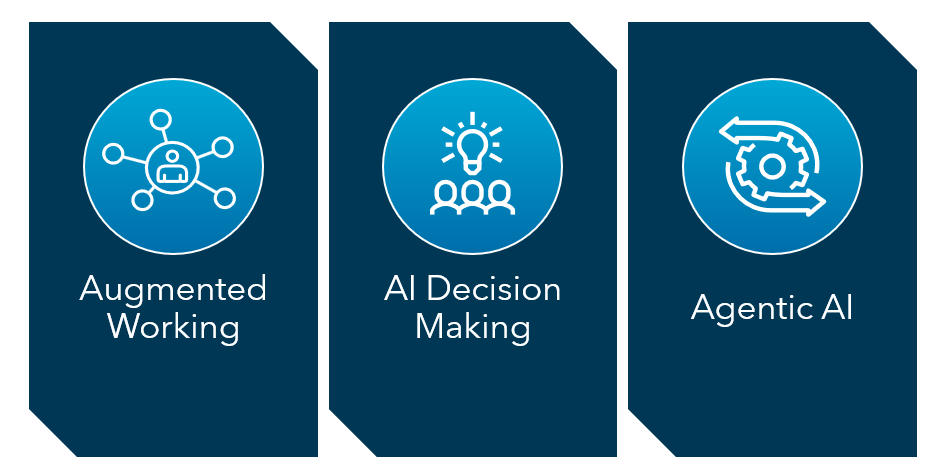
AI is constantly evolving. Currently, the most important emerging trends to note are augmented working, automated decision making and agentic AI.
Augmented Working
In an AI-augmented workforce, humans and AI work together. With AI-enabled tools, your workers can do their jobs smarter and faster, boosting their productivity. It’s important to note here that AI is not replacing workers but is rather enhancing how they work.
Real-Time Automated Decision Making
AI decision making relies on advanced machine learning algorithms and data processing to analyze extremely large data sets and make quick, actionable decisions. For example, an AI system for a restaurant can analyze trends and sales data and provide recommendations for improvement.
Agentic AI
Agentic AI solutions are a step up from traditional AI tools like chatbots in that they initiate tasks, plan actions and adapt based on outcomes. Workers can assign specific tasks to these systems and step in when human involvement is needed.
What Are the Major Jargon Words Related To AI That I Need To Know To Be Up to Date?
One of the hardest parts of learning about AI is navigating the lingo. Some of the most important terms to know are listed below, along with their related uses, pros and cons.
Generative AI
“Generative AI” refers to AI models that can create content based on patterns learned from data.
Generative AI can be used to enhance creativity through idea generation and design, increase personalization through the creation of tailored content and improve productivity through streamlined workflows.
It’s important to note that generative AI may also produce biased, nonsensical or inaccurate content, which can create misinformation. There are also issues with the copyright of data used to train the AI.
Machine Learning
“Machine Learning” refers to a subset of AI in which computers and machines are trained to mimic how humans learn, with the algorithms improving over time without being programmed.
There are several different types of machine learning, including:
- Supervised learning – Algorithms are trained using labeled data sets
- Unsupervised learning – Finds patterns in unlabeled data
- Reinforcement learning – Learns by interacting with the environment through trial and error
Machine learning can increase your business’s accuracy and efficiency. It’s very useful for data forecasting tasks, such as for supply chain management, and it can help with creating data-driven business strategies.
On the other hand, it can be difficult to obtain high-quality, relevant data, and it can be inconsistent. Plus, depending on the application or use case, training models may require extensive computing power and time.
Neural Network
“Neural Network” refers to a type of machine learning algorithm, modeled after the human brain with interconnected neurons, that processes data in complex ways.
A neural network can be used for diverse tasks like vision and audio; it learns from large datasets and adapts well. However, training a neural network requires significant data and computing resources. For example, training for image detection requires the use of thousands of training images.
Foundation Models
A “Foundation Model” is a large pre-trained AI system created to complete broad ranges of tasks with minimal additional training. Real-world applications include healthcare, chatbots, computer vision and more.
Foundation models are trained on a broad range of unlabeled datasets using self-supervised learning techniques. The models can be adapted for specific tasks using smaller, task-specific datasets.
Foundation models are versatile and are suitable for a wide range of industries and applications, but they lack transparency. It can be unclear how models arrive at their outcomes, which can result in accountability issues.
If I Choose Not To Use AI and My Competition in Business Does, What Advantages Might They Gain?
Because AI is such a transformative tool in terms of efficiency, customer satisfaction, innovation and overall market position, not using it will put your business at a disadvantage. Your competitors are likely to outperform your business in these areas.
More than 60% of businesses believe AI will increase company productivity, and 72% of businesses have already adopted some form of AI into their operations.
What Are Some of the Ways AI Might Expose My Company to Risk?
Privacy is a primary concern for businesses using AI. AI tools are trained on extremely large datasets, and in some cases, it can be hard to know if personal information is included in the data. The inclusion of the data, purposely or not, can be in violation of privacy regulations.

Ethical dilemmas are also at play. There is still not much transparency in AI systems regarding how decisions are made. This obscurity underscores the question about how AI should be regulated. There is also the danger of bias. If the datasets that AI systems are trained on contain bias, the AI is likely to reflect those biases.
And while AI can positively streamline many processes in your business, it can also upend established processes in your business in a negative way—especially if you integrate AI without planning or consideration. It’s important that your AI usage aligns with your business objectives.
Can AI Be Helpful From a Cybersecurity Standpoint? If So, How?
Yes, AI can provide several opportunities to improve your organization’s cybersecurity posture.
AI-enabled threat detection solutions can quickly analyze vast amounts of data, including network traffic, system behavior and security logs, in real time. Its data power extends to threat intelligence gathering, siphoning data from various sources to proactively prevent breaches and detect attack techniques. It can also automate threat prioritization based on factors like risk level and potential impact.
AI-powered tools can also enable you to detect emerging threats 96% faster than traditional methods. And early detection is critical for addressing a threat before it has a chance to escalate.
You can strengthen identity protection by using AI to power adaptive and continuous authentication methods. These adaptive AI systems use machine learning to assess, in real time, factors like user behavior, location and device type during login.
AI can also be used to allocate resources more efficiently while automating security processes, like security patch application or isolating compromised systems, which can minimize the need for human action.
How Do I Begin to Leverage AI for My Business?
It’s impossible to ignore how AI is reshaping entire industries and redefining what it means to be a competitive business. But with the hype surrounding AI, it can be easy to lose sight of exactly what it is and how you can use it for your particular business.
To learn more about how your organization should respond to trends in AI, connect with your Warren Averett advisor directly, or ask a member of our team to reach out to you.