
Does Your Company’s Artificial Intelligence Use Qualify for the R&D Tax Credit?

Automation and artificial intelligence (AI) are continuing to revolutionize business operations.
The impacts of AI aren’t limited to businesses in the technology industry. Companies in nearly every arena are using these advancements to enhance efficiency, prioritize innovation and maintain a competitive edge. And many are even developing their own proprietary AI technologies.
Beyond the operational benefits your company gains through these tools, you may be eligible for financial benefits as well. If your company is developing or researching AI technology to improve processes and procedures, you may be able to claim the Research and Development (R&D) Tax Credit.
What Activities Qualify for the R&D Tax Credit?
Eligibility for the R&D Tax Credit hinges on the nature of the activities undertaken, rather than the specific technology used. So, developing or implementing AI technologies is subject to the same criteria for the R&D Tax Credit as any other software development or implementation project.

For any activity to be considered as a qualified research activity and expense under the R&D Tax Credit, it must meet the following criteria, often referred to as the “four-part test:”
1. Elimination of uncertainty
The process must seek to discover information that could eliminate uncertainty about a product or process’s design, methodology, development or improvement.
2. Process of experimentation
The activities must involve a process of experimentation, such as modeling, simulation, systematic trial and error or other methods.
3. Technological in nature
The research must rely on principles of biological or physical sciences, engineering or computer science.
4. New or improved business component for a permitted purpose
The purpose of the R&D should be to apply the information discovered to develop a new or improved business component, such as a process, product, software or formula that will be used internally or offered for commercial purposes.
If your R&D activities qualify for the tax credit, it can help offset your qualified research expenses (QREs). QREs include:
- Wages paid to employees conducting or directly supervising or supporting the R&D activities
- Supplies used in the R&D process
- Certain third-party contractor expenses, provided the work performed qualifies as R&D activities under the tax credit criteria
- Cloud computing costs
What Kinds of AI-Related Activities Could Qualify for the R&D Tax Credit?
Many AI activities can potentially pass the four-part test and qualify for the R&D Tax Credit. Examples could include:
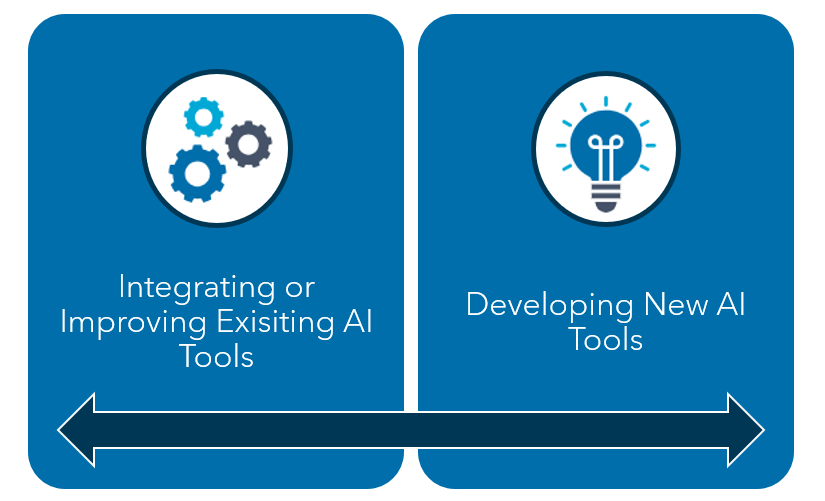
Developing New AI Algorithms or Models That Advance AI Technology
This includes research into machine learning, natural language processing or neural networks to solve novel or complex problems.
Improving The Performance, Accuracy or Efficiency of Existing AI Systems
This can include refining algorithms to reduce computational requirements or improve decision-making processes.
Integrating AI Into Existing Products or Processes
This encompasses developing smart systems, automating manual processes or enhancing data analytics capabilities to improve functionality, efficiency or user experience.
Developing Custom AI Solutions To Address Unique Challenges in Specific Industries
Examples include AI-driven diagnostic tools, automated financial advising systems or predictive maintenance for industrial equipment.
How Can Companies Investing in AI Benefit From the R&D Tax Credit?
By reducing a company’s tax liability, the R&D Tax Credit directly impacts the bottom line, making it a valuable asset for businesses investing heavily in AI. This financial relief can ease the economic burden of innovation and allow companies to reinvest savings into further R&D, hire additional talent or expand their operations.
Beyond the immediate financial benefits, leveraging the R&D Tax Credit can enhance a company’s attractiveness to investors and stakeholders. In today’s market, there is a growing appreciation for businesses that commit to innovation and technological advancement.
Investors are increasingly drawn to companies that demonstrate a proactive approach to R&D, viewing such commitments as indicative of long-term growth potential and competitive resilience.
If My AI-Related Activities Qualify, How Much Can the R&D Tax Credit Save My Company?
The amount of the R&D Tax Credit depends on several factors and can be calculated in one of two ways: the regular (traditional) method or the Alternative Simplified Credit (ASC) method.
While a deep dive into the calculations is beyond the scope of this article, it typically allows a company to apply a certain percentage of its annual eligible costs, dollar for dollar, against its federal income tax liability. Any unused credits can be carried back one year and carried forward up to 20 years.
Moving Forward With R&D Tax Credits for AI Development or Implementation
Developing and implementing AI tools often comes with significant financial commitments. The R&D Tax Credit can help offset the substantial costs of pursuing technological advancements in AI.
If you’d like to learn more about if your company’s AI or automation activities could qualify for the R&D Tax Credit, contact your Warren Averett advisor directly or ask one of our advisors to reach out to you.
This article was originally published on March 13, 2024, and most recently updated on January 19, 2026.