
M&A Accounting Aspects Are Changing for Government Contractors

An accounting rule known as ASU 2021-08 is changing the way companies recognize and measure contract assets related to liabilities in business combinations. This guidance is particularly significant in the government contracting industry, where complex business combinations are especially common.
Here, we’ve outlined what the new accounting standard means for government contractors considering a merger or acquisition—and tips for overcoming hurdles to compliance.
What Is ASU 2021-08?
In October 2021, the Financial Accounting Standards Board (FASB) issued Accounting Standards Update (ASU) 2021-08, Business Combinations (Topic 805): Accounting for Contract Assets and Contract Liabilities From Contracts With Customers.
The guidance requires nonpublic entities (NPEs) to recognize and measure contract assets and contract liabilities acquired in a business combination in accordance with Topic 606, Revenue From Contracts With Customers beginning in 2024 (for years beginning after December 15, 2023).
The primary purpose of this rule is to improve transparency and comparability by standardizing the way revenue contracts with customers are recognized and measured, regardless of whether or not they are acquired through business combinations.
Applying Topic 606 ensures companies account for revenue contracts consistently, providing clear insights and reducing discrepancies that arise from differing accounting practices between acquired and existing contracts.

When Does ASU 2021-08 Take Effect?
ASU 2021-08 applies prospectively, meaning it only affects transactions occurring on or after:
- Fiscal years beginning after December 15, 2022, including interim periods within those fiscal years, for public business entities
- Fiscal years beginning after December 15, 2023, including interim periods within those fiscal years, for all other entities
Early adoption is permitted. However, entities that opt for early adoption must apply the standard to all business combinations within the year of adoption.
This requirement can be complex, particularly for organizations with multiple acquisitions within the same fiscal year—a scenario we see often, especially after private equity firms have invested in an organization and are looking to drive growth.
What Should Government Contractors Planning M&A Activity Take Away?
For government contractors with M&A activity, there are a few steps to take in light of this standard to proactively prevent issues, help integrate new entities smoothly and maintain compliance with the updated standards.
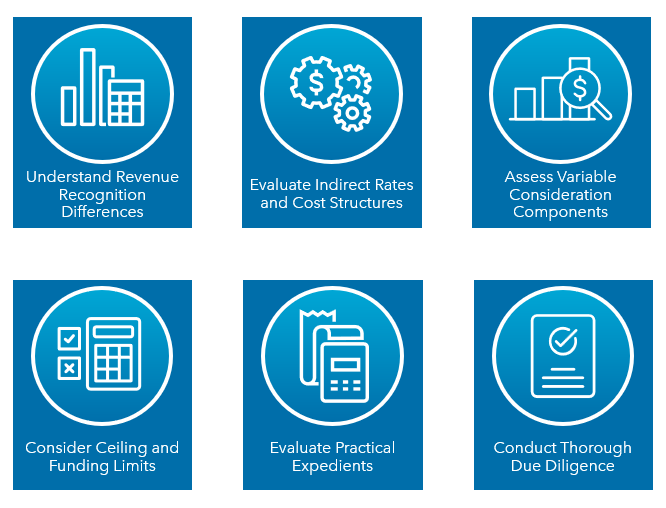
Understand Revenue Recognition Differences
Contractors must prioritize understanding potential revenue recognition differences between the acquirer and the acquiree. These differences can impact the timing and amount of revenue recognized.
Evaluate Indirect Rates and Cost Structures
Differing cost structures and indirect rates between merging entities can influence the costs used in determining the estimate at completion (EAC) and percentage of completion for long-term contracts. Properly evaluating these differences helps avoid financial discrepancies.
Assess Variable Consideration Components
Award fees, incentives and other types of variable consideration often associated with government contracts may be performance-based and require significant judgment. Assess how to recognize and measure these components under Topic 606 to ensure you’re compliant.
Consider Ceiling and Funding Limits
Consider ceiling and funding limits and potential loss provisions that may apply to contracts. These factors influence contract asset and liability valuation during a business combination.
Evaluate Practical Expedients
The use of practical expedients can simplify certain aspects of revenue recognition. For example:
- Under Topic 606, if the time between delivering goods or services and receiving payment is one year or less, the company can record revenue at its full value, either spread over time or all at once.
- Topic 606 allows businesses to recognize revenue based on the work completed to date if they have the right to invoice the customer for that specific amount.
- Topic 606 states that a business doesn’t have to record certain costs related to getting a contract if it expects to recover those costs within one year.
- The new ASU allows the acquiring company to determine the selling price at the time of acquisition instead of at the start of the original contract.
Evaluate these practical expedients carefully to ensure they align with the acquiring entity’s accounting policies and practices.
Conduct Thorough Due Diligence
Thorough due diligence is essential for mitigating risks and aligning accounting practices post-acquisition. This includes understanding the acquiree’s accounting policies, verifying the accuracy of input data and assessing the impacts on key financial ratios.
Learn More About M&A Accounting and Setting Up a Smooth Transition
ASU 2021-08 is complex and has deep implications for M&A activity that require thorough preparation and informed decision-making. Connecting with experienced advisors can ensure you fully understand the standard, apply it accurately and retain essential information needed for disclosure in your financial statements.
If you’d like to learn more about structuring your compliance efforts and streamlining the integration process during business combinations, contact your Warren Averett advisor directly or ask a member of our team to reach out to you.