
The 2 Priorities of Every Financially Healthy Construction Business

The construction industry is extremely unique.
Cash receipts typically come in large amounts, but they occur infrequently. Cash disbursements are typically small amounts, but they occur frequently throughout a project’s life cycle.
This creates a complicated dynamic for sound financial management and profitability. Not only do contractors have to plan for positive cash flow, but they must also control costs despite weather delays, supply chain delays, changes in scope and labor increases.
The good news is that, by focusing on two key areas—cost management and positive cash flow—contractors have a stronger likelihood of success.
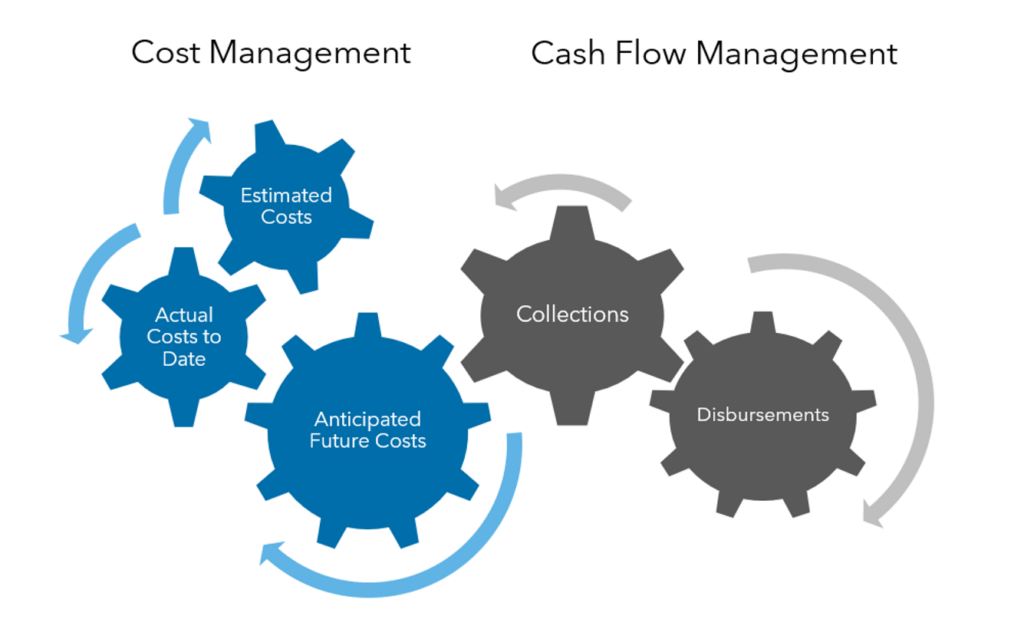
Cost Management
Cost management involves analyzing three areas:
- Estimated costs incorporated into the bid
- Actual costs to date
- Anticipated future costs
Estimated Costs
Preparing sound job cost estimates during pre-construction is an essential first step to successful financial management.
Your original bid costs should consider indirect expenses. Indirect labor, supervision, insurance, depreciation, tools and supplies all affect your construction activities, even though they may be hard to identify with one particular job. Having a grasp on these indirect costs will provide insight into the profit margin or markup needed in your bid amount. Any costs that are not related to construction should be considered overhead.
Contractors that understand the run rate on their overhead and fixed costs will be able to determine how much volume is needed to break even or achieve profit goals.
Estimated costs in your bids should be broken down into small components (work packages) to more effectively monitor cost overruns once the project is underway. Estimated cost categories that are too broad may only show cost overruns at the end of a job—when it’s too late to react.
Because labor is one of the most volatile costs to estimate, your labor estimates should consider the different skill levels needed, trade pay scales, prevailing wage rules, ability to use merit shop or union labor and site conditions that may affect productivity.
Having standard estimating procedures can prevent estimating inconsistencies from one job to the next, and having an estimating team visit a job site can help uncover unanticipated site conditions.
If accurate estimates are made, you can begin to buy out the job through purchase orders and commitments, which can often lead to increased profitability if you’re able to purchase materials at a lower cost than the bid amount.
Also, keeping the estimating team involved throughout the project’s lifecycle can help identify price escalations, support change orders and adjust budgets.
Actual Costs to Date
Once your initial estimate is set, it’s important to track job costs incurred accurately and in a timely manner. This allows you to review costs frequently in order to identify potential job delays and scope changes. It can also help to diagnose profit fade, which is often linked to incorrect estimating or poor project management. Having this information readily available gives you the ability to react quickly to mitigate losses and consider any change orders necessary.
To identify instances of poor estimating and poor project management, ask yourself:
- Was there work required under the original contract that was overlooked in the estimate?
- Is the project manager exercising sound change order management?
- Are the subcontractors staying on schedule?
- Are the design specifications provided in a timely manner, and are they feasible for construction?

Budget-to-actual reports are meaningless if the job costs are recorded inaccurately, which means that the individual responsible for coding the job costs should be extremely familiar with the job cost estimates.
Anticipated future costs
The last key to the cost management equation is estimating the future costs to complete a job.
Frequent communication between the project manager, superintendent, estimating team and accounting department about the estimated cost to complete a job is extremely important; each role brings various insights to the project’s progression. Having frequent meetings facilitates discussions about potential change order opportunities, project delay claims and overall progress on the job.
Often times, there is a disconnect between the field and the office, which can lead to poor project performance and unexpected cost overruns. That’s why superintendents and project managers should seek input from the estimating team when revising the cost-to-complete estimate. These cost-to-complete estimates should be analyzed on each work package unit used for estimating the job, rather than in broad categories, in order to identify potential issues early in the job.

Having a purchase-order system in place can help identify unaccounted for costs yet to be spent early in the job cycle. The most important factor is that estimated costs are updated frequently so that management can identify budget-to-actual overruns early on—while there may be time to negotiate for price escalations, etc.
Cash Flow Management
Cash is the oxygen to a business. Highly profitable contractors have had to shut their doors because of cashflow issues.
Proper cash flow management is based on two principles: speeding up collections and slowing down disbursements. Both of these aspects can largely be negotiated in the contract terms, such as the frequency of the billing cycle, retainage amounts, ability to bill for stored materials or timing of incentive payments.
Collections
Cash flow management can be even more important for subcontractors in a “pay-when-paid” contract, as this can result in significant retainage outstanding for the life of the job, long after the subcontractor has had to pay expenses. The key is to generally stay overbilled on projects, which can be accomplished by front-end loading the schedule of values for costs incurred during the early stages of the job (like general conditions, site preparation or excavation).
Disbursements
Maintaining a committed cost system will help forecast cash disbursements to pay vendors and subcontractors. The goal is to schedule material delivery just in time to slow the cash disbursement function.
Monitoring your revenue backlog can indicate if you’re overextended, which could put a strain on working capital and cash flow. If you have excess cash, taking vendor discounts may be a good means to increase profitability. As an illustration, for 2/10 net 30 terms, the effective annual interest rate is about 36%.
Learn More About Maintaining Your Construction Company’s Financial Health
The construction industry has unique financial dynamics that create distinctive challenges for contractors—but there’s also immense opportunity if you have the right strategy in place.
To learn more about how your organization should be managing your cash flow and costs, connect with your Warren Averett advisor directly, or ask a member of our team to reach out to you.