
Disaster Recovery Policy vs. Disaster Recovery Plan: What’s the Difference?

Every organization needs a disaster recovery policy and disaster recovery plan to be prepared for an unforeseen event.
When they are both developed and managed properly, these two tools can be essential for helping your organization restore any lost data, protect your IT infrastructure and return to normal business operations as soon as possible.
So, what is a disaster recovery policy? How is it different than a disaster recovery plan? Does your business really need both?
Here, we explore the difference between a disaster recovery policy and a disaster recovery plan, as well as how they interact with each other so you can establish the strongest response for your organization.
Disaster Recovery Policy vs. Disaster Recovery Plan: Use
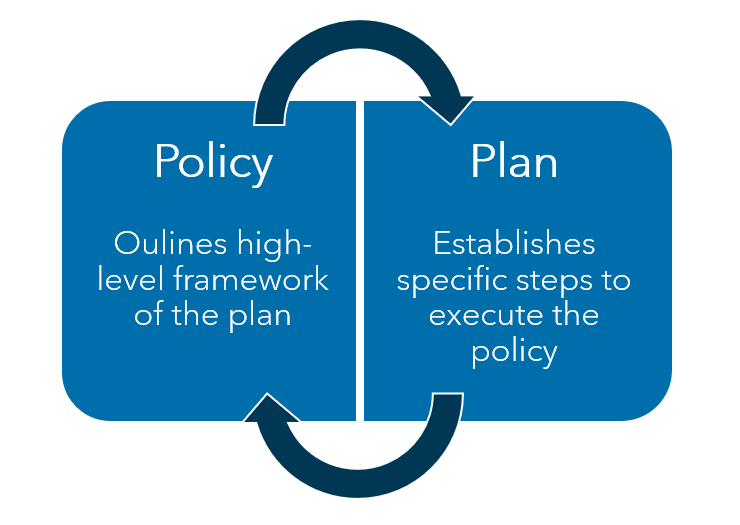
A disaster recover policy is used to clearly define and establish scope, responsibilities, commitments and expectations when a disaster occurs. The policy directs the framework and general rules of the disaster recovery plan by generally outlining the disaster recovery efforts.
The disaster recovery plan is a detailed guide that documents exactly what actions should be taken to address specific issues and recover when an event, such as a cyberattack or natural disaster, occurs.
Disaster Recovery Policy vs. Disaster Recovery Plan: Contents
The disaster recovery policy operates at a high level, encompassing the entire organization’s response to an interruption. For example, for a university, a disaster recovery policy would apply to all members of the university community, including students, staff, faculty, administrative officials, etc.
While your organization’s industry and specific situation will help form your disaster recovery policy, every policy should contain information about these four things:
- The need for a plan
- The compliance or regulatory requirements that the plan is subject to
- A review process for the plan
- The other tools and procedures needed for business to continue after a disaster
The disaster recovery plan provides the granular details for specific risks, strategies, communication protocols, tools, testing procedures, etc. No two disaster recovery plans are the same, but a typical disaster recovery plan is likely to include basic elements such as:
- Technology-based objectives of the plan
- A list of individuals involved and their roles in executing the plan
- Possible disaster scenarios and responses
- Procedures for restoring systems
- Inventory of assets
- Recovery site locations
- Specific and actionable information for restoring critical processes and

No two plans or policies are expected to be exactly the same, as the particulars of your organization will help shape the exact contents of both documents.
Disaster Recovery Policy vs. Disaster Recovery Plan: Audience
Organization leaders, managers, executives and any other decision makers are the key players in a disaster recovery policy. It’s important that these decision makers understand what has to be done when a disaster occurs and that they use the policy as a guide for making those decisions.
On the other hand, the disaster recovery plan is used to guide action when a disaster occurs and is intended for those individuals who are responsible for the actual execution of the plan, such as the IT staff or the disaster recovery team. Everyone involved should understand their role during a disaster.

Disaster Recovery Policy vs. Disaster Recovery Plan: Updates
A disaster recovery policy is likely to remain relatively stable over time. There may be some instances in which it may require some updating, such as when there are new, significant regulatory or compliance requirements applicable to disaster recovery. However, because the disaster recovery policy is limited to describing the general scope of your organization’s disaster recovery, it is unlikely that you will have to update it very often.
In contrast, the disaster recovery plan must be regularly updated to accommodate changes, like new cyberthreats and risks. Changes within your organization, such as with personnel, processes or system infrastructures, are also cause for updating your disaster recovery plan.
One way to ensure that your plan is always up to date is to have regularly scheduled evaluations of your plan. Updating, along with testing, is necessary for having a plan that is relevant enough to be effective in any disaster scenario.
Learn More About Preparing Your Organization for a Disaster
Technology has a role in nearly all aspects of how an organization operates. To ensure that your organization is able to return to its pre-disaster operational state as soon as possible, both a disaster recovery plan and a disaster recovery policy should be documented and practiced by your organization.
Any unexpected downtime or system interruption can have long-lasting and severe consequences for your organization. To protect your organization’s reputation, mitigate losses and enable business continuity, you need to have the right disaster recovery policy and disaster recovery plan. If you need help developing your organization’s disaster recovery policy or disaster recovery plan, contact a Warren Averett advisor today to schedule a consultation.
