
Independent Contractor vs. Employee: Is Your Company Classifying Workers Correctly?

The Department of Labor (DOL) has revised the way companies should determine which of their workers are considered employees of the business and which are deemed independent contractors.
Understanding the distinction between an independent contractor vs. employee is crucial for businesses to ensure you’re classifying your workers correctly and avoiding the consequences of noncompliance.
Why does it matter which workers are classified as independent contractors vs. employees?
The Fair Labor Standards Act (FLSA) establishes regulations for employers regarding wages and records of their employees. These rules do not apply to independent contractors because these individuals are considered self-employed and manage those issues for themselves.
When businesses hire employees, they take on some key responsibilities on behalf of these individuals, including:
- Withholding and depositing income taxes, Social Security taxes and Medicare taxes from the employee’s wages or salary
- Matching the employee’s Social Security and Medicare taxes
- Paying unemployment tax on wages or salary to an employee
- Offering medical insurance and other benefits, such as paid time off
None of these provisions for employees apply to independent contractors, who instead provide specific services and agree to receive payment based on the project, hour or some other finite increment.
Independent contractors are responsible for all of their own tax- and insurance-related matters. They also receive no employee-specific benefits, like paid time off.
How should companies determine which team members are independent contractors vs. employees?
A new DOL rule (effective March 11, 2024) has reshaped how companies classify employees.
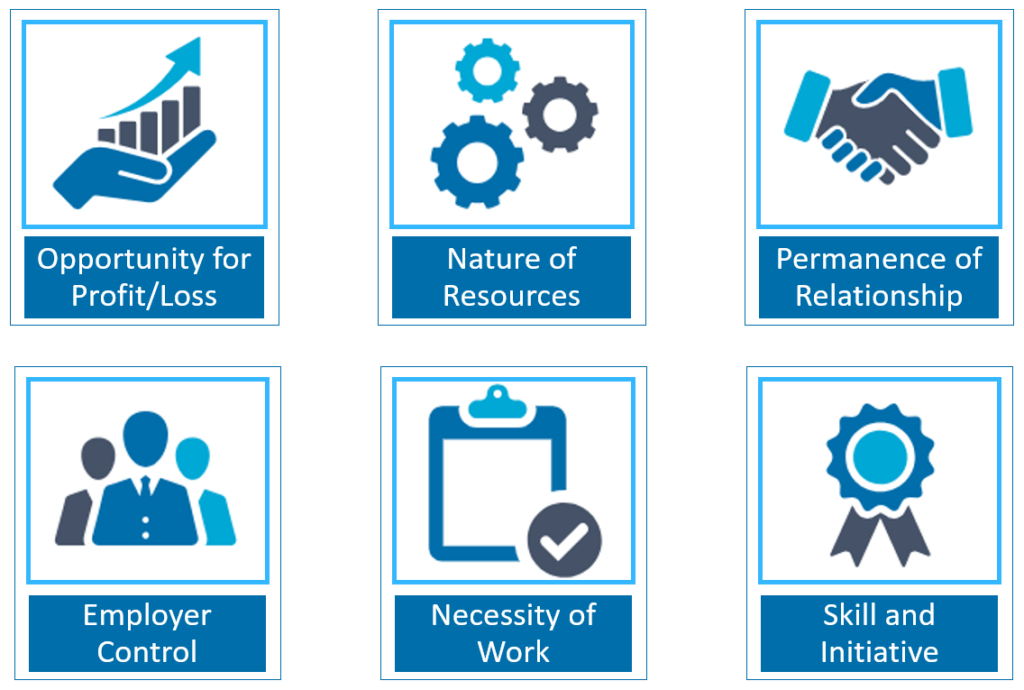
To determine whether an individual is an independent contractor vs. employee, it’s important to refer to the FLSA’s six-factor economic reality test. This test explores the economic realities of the worker’s relationship with the employer.
The six-factor economic reality test consists of the following:
- Any opportunity for profit or loss a worker may have
- The financial stake and nature of any resources invested by a worker
- The permanence level of the work relationship
- The control an employer has over the person’s work
- How essential the work performed is to the employer’s business
- A factor regarding the worker’s skill and initiative
Ultimately, if the economic reality shows that the individual is economically dependent on the employer, the worker is then classified an employee, which entitles the worker to more employee benefits and legal protections.
The new rule reinforces the DOL’s pro-employee view of worker classification, which allows more employee benefits to be granted to workers. However, it may create complications for business owners reliant on independent contractors and those participating in the continually growing and evolving gig economy.
What are the consequences for misclassifying employees?
Employers who misclassify employees or independent contractors stand to face significant penalties, fines, employee or contractor lawsuits, and a tarnished reputation for not affording both categories proper recognition and treatment.
Legal Consequences
Misclassified workers may be denied important labor law protections and benefits, such as minimum wage, overtime pay and workplace safety regulations. For this infraction, employers may face penalties and legal action.
Misclassified workers or government agencies can also file lawsuits against employers for wage and hour violations. If found guilty, employers may have to pay back wages, fines and legal fees.
Tax Implications
Employers are responsible for withholding and paying employment taxes, including Social Security and Medicare for employees, so misclassifying workers as independent contractors can lead to tax issues.
Reputational Impact
Misclassification can harm a company’s reputation, as it can be seen as an attempt to avoid legal obligations and employee protections.
What should my company do if we aren’t currently compliant with the DOL’s rules for classification?
If your company is not currently compliant with the DOL’s new measures for employee classification, you still have time to become compliant before the new rule is effective.
Correcting after it has occurred can be costly for employers, so it’s important to make accurate classifications regarding independent contractors vs. employees.
Contact us to learn more about what steps your unique organization should take in this area and how to maintain your overall human resources compliance program.