
The One Big Beautiful Bill Breakdown: Energy Tax Credits

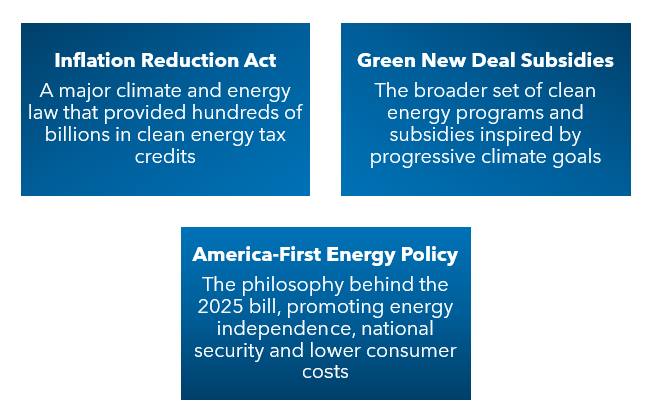
Under the One Big Beautiful Bill, many of the clean energy tax credits introduced under the Inflation Reduction Act—often associated with Green New Deal-style subsidies—were either eliminated or substantially restricted. However, the bill expanded support for the America-First Energy Policy.
The Previous Tax Law
Before the One Big Beautiful Bill was signed into law, energy tax credits were largely shaped by the Inflation Reduction Act of 2022, which focused on accelerating the transition to clean energy. Some of the most notable energy-related tax credits included:
- The Previously-Owned Clean Vehicle Tax Credit (25E) allowed for a credit of $4,000 or 30% of the vehicle price (whichever is less), and it was set to terminate for vehicles acquired after 2032.
- A Clean Vehicle Tax Credit (30D) of $4,000-$7,500 was offered for the purchase of clean vehicles placed in service before 2033.
- The Qualified Commercial Clean Vehicle Tax Credit (45W) provided a credit of up to $40,000 for the maximum qualified vehicles.
- The Alternative Fuel Vehicle Refueling Property Tax Credit (30C) offered a 30% tax credit of up to $1,000 per qualifying item and was originally set to terminate December 31, 2032.
- Residential Clean Energy Tax Credit (25D) was calculated at 30% of the costs of qualifying, new clean energy property and was originally set to terminate December 31, 2032.
- The Energy Efficient Commercial Buildings Deduction (179D) was originally set to expire at the end of 2026.
- The New Energy Efficient Home Tax Credit (45L) provided a credit ranging from $500-$5,000 for constructing qualified energy efficient homes, and it was originally set to terminate December 31, 2032.
- The Zero-Emission Nuclear Power Production Tax Credit (45U(c)) is a tax credit based on the amount of energy produced and sold to an unrelated entity.
- The Clean Hydrogen Production Tax Credit (45V(c)(3)(C) is a tax credit calculated using the qualified clean hydrogen produced at a qualified facility.
- The Clean Electricity Production Tax Credit (45Y(d)) is calculated on electricity produced from renewable sources at qualified facilities placed in service after December 31, 2024. This credit was set to expire after December 31, 2032
- The Clean Electricity Investment Credit (48E(e)) is an emissions-based tax credit on a qualified facility used to generate electricity and was scheduled to expire December 31, 2032.
- The Advanced Manufacturing Production Tax Credit (45X(d)), is provided for the production and sale of eligible clean energy components.
- Clean Fuel Production Tax Credit (45Z(f)(1)(A) was designed to incentivize the production of clean transportation fuels.
- The Carbon Oxide Sequestration Credit (45Q(f)) incentivizes the capture and secure storage or use of carbon oxides.
New and Final Law Under the One Big Beautiful Bill
Several clean energy-related tax credits and deductions—including those for clean vehicles, commercial clean vehicles, alternative fuel refueling property, residential clean energy, energy-efficient commercial buildings and homes and clean hydrogen production—are scheduled to terminate between September 30, 2025, and December 31, 2027.
 The Zero-Emission Nuclear Power Production Credit (Section 45U(c)) will continue to expire as originally planned for tax years beginning after December 31, 2032, though specified foreign entities are no longer eligible to claim the credit effective immediately.
The Clean Electricity Production Credit will end for facilities placed in service after December 31, 2027, with new restrictions on foreign entity investments applying to facilities that begin construction after December 31, 2025.
The Clean Electricity Investment Credit will end for qualified property placed in service after December 31, 2027, and new restrictions will apply to facilities with foreign entity investments.
The Advanced Manufacturing Production Credit is partially terminated, with the remaining portions significantly restricted.
The Clean Fuel Production Credit was extended through December 31, 2029, with additional restrictions relating to feedstock sources and foreign ownership. It did retain its credit transferability.
The Carbon Oxide Sequestration Credit was increased for specific projects with additional restrictions applied for foreign ownership.
What It Means for You
The termination of a significant portion of the energy credits will cause many taxpayers to reconsider their plans for expanding and investing in energy efficiency and renewable energy projects. The reduction in subsidies will result in higher overall investments and lower rates of return, potentially affecting profitability.
To learn more about how the One Big Beautiful Bill and these specific provisions may impact you, contact your Warren Averett advisor.
