
Your Nonprofit Board of Directors Should Have These Five Characteristics

Nonprofits looking to be as effective as possible in advancing their mission need to have a financially healthy organization. And good nonprofit financial health demands a solid Board of Directors.
Members of a nonprofit Board of Directors serve as the voluntary governance and fiduciary leaders of the organization. A Board of Directors typically oversees the organization’s:
- Budget
- Funding
- Financial development
- The hiring and management of the organization’s CEO
Your board of directors obviously matters a lot for the viability of your nonprofit. So, how do you build a good one?
Five Characteristics of the Ideal Nonprofit Board of Directors
If you’re looking to build the best board of directors possible for your nonprofit organization (which, of course, you always are), it’s important to evaluate your current members and potential candidates in a few key categories.
I’ve outlined five elements that can serve as a blueprint for building the ideal nonprofit board of directors.
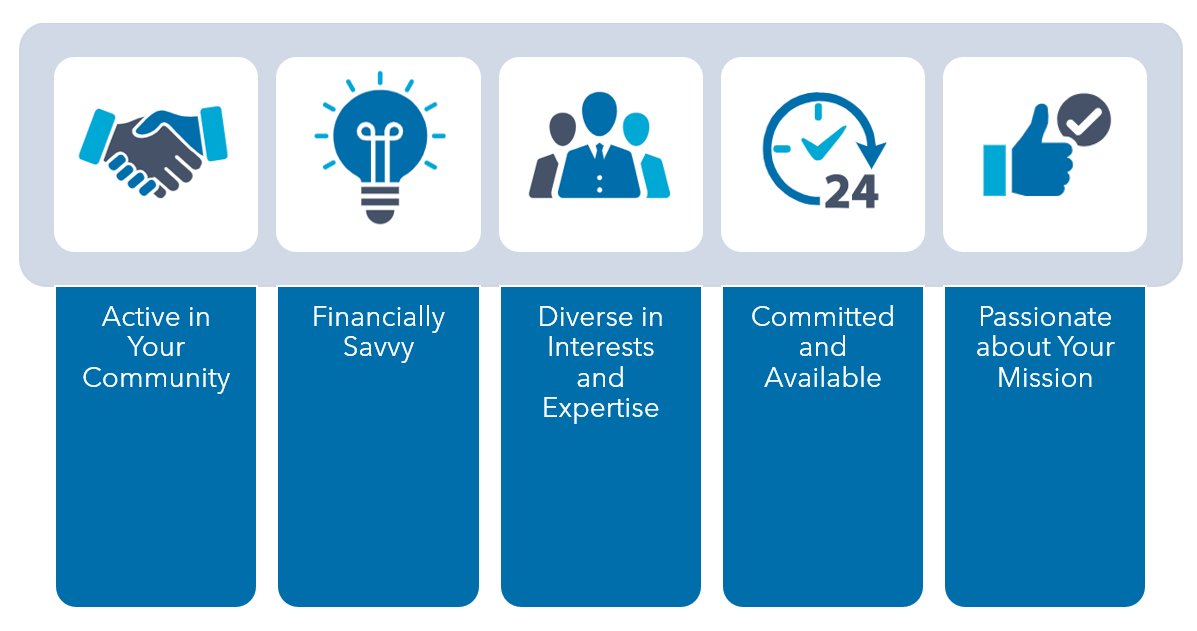
1. Active in the community your nonprofit serves
Having board members who represent and understand the area in which your nonprofit operates will not only enhance their contributions to your mission and development and the connections you make, but will also help to ensure that the insight they give is actually relevant to your organization.
If your nonprofit’s board members aren’t active throughout and planted in the community you serve, it will be difficult for them to serve as an effective planning resource for your organization.
2. Financially savvy and understands fiduciary responsibility
A key ingredient for a successful nonprofit board of directors is solid financial thinking. (Their expertise doesn’t have to be specific to nonprofit organizations.) The stronger your board’s fiduciary intel is, the stronger your financial operations will be, and the more projects you’ll be able to take on.
But, it’s important to remember that each new or potential board member may not already have a strong financial background.
You may need to provide a bit of financial training as part of the onboarding process to really equip your board members to fully embrace this responsibility.

3. Diverse in interests, expertise and representation
It takes a variety of individuals to make your nonprofit board of directors successful, so it’s important to recruit board members with unique interests, strengths and experiences to ensure that your board has different perspectives at the table.
Having a nonprofit board of directors composed of individuals with all the same experiences, the same connections and the same insight may limit your ability to identify and seize opportunities.
Some board members may primarily be a financial asset, some may be door-openers within the community to give you exposure and win connections, and some may be hungry for hands-on service and interactive leadership. One type of board member isn’t necessarily better than another type. To be effective in your mission, you’ll probably need them all.
Just as your nonprofit wouldn’t rely on only one donor to fund all of your activities indefinitely, you shouldn’t rely on one mindset or outlook to guide all of your plans. It’s important to diversify your board of directors, while still staying true to your nonprofit’s mission.
Your board members should share your nonprofit’s values, but their way of life and thinking will often be unique from other board members.
It’s also important to pursue a diverse board of directors that reflects the characteristics of the communities you serve. Having a board that is acquainted with the needs of the community and can represent them in your organization’s conversations is an invaluable asset.
4. Committed and available
Your nonprofit board of directors should understand that their role comes with a commitment to share their time, resources and abilities.
They should be willing to be available when you need them and be aware of your organization’s goings on. If board members consistently miss meetings, dodge event invitations or won’t return your calls, it’s probably time to reevaluate their commitments.
It’s important that your board members understand that they were chosen for their role for a reason, and your nonprofit relies on them, so they need to be willing to be available to you and acknowledge the commitment.
Be clear in communications about expectations—both for what your board of directors will do to support your nonprofit and what your nonprofit will do to support your board of directors.
Unfortunately, some individuals who show interest in joining your nonprofit board of directors may just want to have a new item on their resume, and they may not actually have the time to do their best for your board.
In these situations, having honest conversations about expectations is imperative.
5. Passionate about advancing your nonprofit’s mission
Possibly the most important characteristic a board member should have is passion to further your nonprofit’s mission—the heart of what you do and why.
If your board of directors has a genuine passion for the work that your nonprofit is doing, their willingness and ability to be the type of board member your organization needs will come naturally, and it will strengthen the momentum of your mission.
Learn More about Building a Strong Nonprofit Board of Directors
While most individuals (and some nonprofits) may immediately think of a board member’s financial contribution to a nonprofit, it’s important to remember that if you’re seeking to build a strong board, there’s much more to it.
At the end of the day, building a strong nonprofit board of directors can be one of your greatest assets in advancing your mission.
Want to learn more about advancing the financial health of your nonprofit or building a strong board of directors? Reach out to your Warren Averett advisor, or ask one of our nonprofit consultants to reach out to you.
This article was originally published on January 22, 2020 and most recently updated November 11, 2023.