Avoiding the SOC Wall: How SaaS Companies Keep Deals Moving
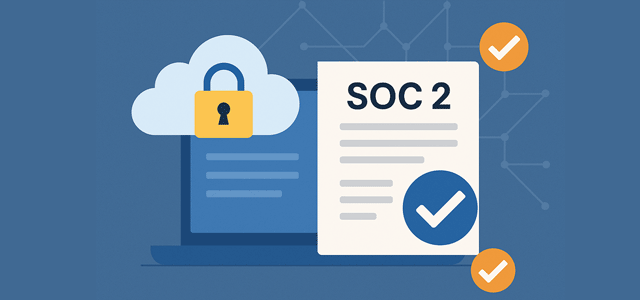
You’re working through a promising sales cycle with a potential customer. Everything’s moving forward until their procurement team sends over a security questionnaire.
The first question is: Do you have a SOC report?
If you don’t, the deal can stall. Or worse, it could fall through altogether. This is the “SOC wall:” the point where SaaS companies can’t scale into securing larger accounts without proving their security posture.
For SaaS companies, this moment is common. Buyers want proof that you take security seriously, and a SOC report is often the ticket to keep deals moving. If your platform handles customer data in the cloud, having a SOC report ready (before your customer asks) is a practical way to avoid delays and show you’re prepared for enterprise growth.
Which SOC Report Does a SaaS Company Actually Need?
For most SaaS companies, SOC 2® is the standard. It focuses on how your cloud platform handles and protects customer data and is often the report required by buyers, especially in regulated industries like finance and healthcare.
SOC 2 addresses Trust Services Criteria specified by the AICPA. Categories addressed can include Security, Availability, Processing Integrity, Confidentiality or Privacy as applicable to the service commitments and system requirements you make to your customers.
SOC 1® may also be relevant if your application processes transactional data that impacts your customers’ financial statements (think accounting or claims processing software). In these cases, you might need both a SOC 1 and SOC 2 Report.
SOC 2 Type 1 vs. Type 2: What’s the Difference and Which Should I Get?
SOC 2 Type 1 assesses your controls at a single point in time. Many early-stage companies use Type 1 as a stepping stone to Type 2, especially if they want to demonstrate progress quickly. However, Type 1 only gives assurance that your controls are suitably designed.
In contrast, a SOC 2 Type 2 report goes further by actually testing your controls over a period of time (usually six to 12 months). This approach is preferred by most large organizations because it demonstrates not just that your controls are well-designed, but that they operate effectively and consistently in practice. Type 2 is especially important if your platform manages multi-tenant environments, CI/CD pipelines or customer-facing APIs, as it signals operational maturity and reliability.
The auditor will review evidence to see if your operational and security controls are working as intended, and then document the results of those tests in the final report. In other words, Type 2 doesn’t just say you have good controls on paper; it shows whether those controls were actually followed and operated effectively during the audit period. This gives your customers more confidence that your security practices are proven in real-world operations.
Ultimately, while Type 1 can help you get started, Type 2 is what most major clients expect when evaluating your security posture.
Can We Skip Type 1 and Go Straight To Type 2?
Yes. Type 1 may be helpful for early-stage SaaS companies that want to show progress quickly, but many companies go straight to Type 2 to meet their customers’ expectations.
If you’re in pre-revenue or MVP-stage, it’s probably best to start with Type 1. Move to Type 2 as soon as you’re in active sales cycles. If you’re unsure which type is the best for your SaaS company, consider a SOC readiness assessment.
When Should a SaaS Company Start the SOC Process?
The right time to start the SOC process is usually when you’re preparing to enter mid-market or large business sales, responding to security questionnaires or gearing up for a new round of funding.
Ideally, you want to begin the SOC process three to six months before you expect to close your first deal with a major customer. Starting early gives you time to address any gaps in your controls and ensures you’re ready when opportunities arise, rather than scrambling to meet requirements after a deal is already on the line.
By planning ahead, you can keep your sales cycle moving smoothly and avoid unnecessary delays.
How Long Does a SOC Exam Take and What’s the Process for SaaS Companies?
The timeline for completing a SOC 2 report depends on the type of report and your company’s readiness.
For a SOC 2 Type 1, the process typically takes about two to three months once you’ve prepared your controls and documentation. If you’re pursuing a SOC 2 Type 2, expect the process to span six to 12 months, since this type of report requires your controls to be tested over an extended period.
The journey starts with a readiness assessment to identify any gaps, followed by remediation to address issues in your policies, access controls or logging practices. Once your controls are consistently implemented, an independent CPA firm will review and test your evidence before issuing the final report.
What Happens After I Get the Report?
Once you receive your SOC report, it’s important to handle it securely and thoughtfully. These reports are restricted-use reports, meaning they should only be shared with customers or prospects who have specific knowledge of your services. They should be distributed through secure channels, such as outlined in an NDA or a dedicated portal.
You can reference your SOC report in sales materials, on your security page or in responses to RFPs, but are restricted from posting the full report online. (Only SOC 3® reports are designed for public sharing, and those are rarely used by startups.)
Keep in mind that most customers will expect SOC reports to be updated annually, so plan to repeat the process each year to keep your reports current.
Do We Need a SOC 2 If We Only Sell to Startups?
If your SaaS company is currently selling only to startups, a SOC 2 report may not be an immediate requirement. Most smaller companies won’t ask for this level of security assurance, so you can often move forward without it in the early stages. However, as your business grows and you begin targeting larger organizations, you’ll likely encounter requests for a SOC 2 report.
What If We Pivot Mid-Exam?
If your product, infrastructure or business model changes significantly during the SOC exam period, you may need to revisit the scope of your audit or even restart the observation window. These kinds of pivots can delay your report and complicate the exam process, especially if changes occur after the audit has already begun.
To avoid unnecessary setbacks, it’s best to finalize your core architecture and operational processes before starting a SOC 2 Type 2 exam. This way, you can ensure the audit accurately reflects your current environment and avoid having to repeat steps or extend your timeline.
We’re Fully Remote—Does That Affect SOC 2?
Operating as a fully remote SaaS company does have an impact on your SOC 2 process. Auditors will expect you to have clear remote work policies in place, covering areas like acceptable use and device security.
You’ll also need to show how you manage endpoints and how you secure access to your systems through measures such as multi-factor authentication (MFA) and VPNs. Access controls for cloud platforms and code repositories are also important.
Ultimately, the exam will look for evidence that your team’s devices and access are properly secured and monitored, even in a distributed environment. Addressing these areas up front helps demonstrate your commitment to security, regardless of where your team works.
Do I Still Need My Own SOC Report If My Cloud Provider Has One?
While major cloud service providers like AWS, Azure or Google Cloud do maintain their own SOC reports, these only address the security and controls of their infrastructure—not your SaaS platform or how you handle customer data.
As the SaaS provider, you’re responsible for your own controls, including how you manage access, log activity and respond to incidents. SOC 2 is designed to evaluate your specific practices, not those of your vendors, so relying solely on your cloud service provider’s SOC report won’t satisfy your customers’ requirements or protect your business.
Learn More About SOC Reports for SaaS Companies
Whether you’re just beginning to target larger organizations or planning for future expansion, investing in your security posture now will pay off when new opportunities arise. To learn more, contact your Warren Averett advisor directly, or ask a member of our team to reach out to you.