
How Government Contractors Can Streamline M&A Activity by Improving Business Processes

For today’s government contractors, change is the only constant.
Tariffs shift, Department of Governmental Efficiency (DOGE) initiatives take hold and budget priorities can pivot overnight. For many government contractors, these forces make mergers and acquisitions more challenging; however, strong business processes and internal controls help accelerate the selling process.
Without deliberate attention to integrating and refining business processes, even the most promising deal can result in redundant systems, compliance gaps and costly inefficiencies.
For government contractors involved in M&A, strong business processes aren’t optional. They’re the key to protecting contract value, staying compliant and making the deal work.
Why Government Contractors Should Review Their Business Processes
In the highly regulated and competitive government contracting market, business processes directly influence market value and M&A attractiveness. A disciplined process review can:
- Increase competitive positioning – Understanding how team members execute tasks helps leadership identify differentiators and refine value propositions when pursuing new opportunities.
- Ensure compliance and manage risk – Government contractors must comply with stringent federal regulations. A thorough process review can uncover deficiencies in accounting, estimating, procurement systems and revenue recognition that could expose the contractor to audit findings, issues discovered in due diligence related to a potential transaction, disallowances and penalties.
- Identify automation opportunities – Contractors can often automate manual, repetitive tasks through integrated ERP or contract management solutions, reducing error rates and freeing staff for higher-level work.
- Verify adequate resources and system utilization – Post-acquisition, overlapping tools and insufficient training can lead to underused technology. Process reviews help team members fully leverage systems so they’re adequately resourced to support compliance and performance.
- Enhance targeted reviews over key information – Streamlining and centralizing data access helps leaders perform targeted reviews on high-risk or high-value areas, such as indirect rate calculations or subcontractor compliance.
- Support financial reporting – Internal management reports and external financial statements must be complete, accurate and on time. Inaccurate reporting misinforms decisions, erodes stakeholder trust and can even jeopardize contract performance.
Issues That Commonly Impact Transactions for Government Contractors That Can be Addressed with a Business Process Review
Operational and compliance issues can affect transaction value and terms. For government contractors, these matters often surface during due diligence, leading to purchase price adjustments, indemnification requirements or even deals falling through.

Revenue recognition is a focal point in most government contracting transactions. Improper revenue recognition can lead to buyers changing their view of the company’s historical revenue and forecasts. Improper revenue recognition can lead to many issues in a transaction and should be corrected prior to buyer due diligence.
Additionally, properly tracking deferred revenue (i.e., funds received but not yet earned) is particularly important. The treatment of deferred revenue is typically heavily negotiated within the overall economics of the transaction. It is imperative to track deferred revenue accurately, including the money that has been spent to service projects which have deferred revenue balances.
Differences between actual and provisional indirect rates can also have real financial consequences for government contractors. If your actual rates come in lower than expected, you might owe money back to the government on cost-reimbursable contracts. But if your rates are higher (and there’s room in the contract), you could be entitled to additional reimbursement. It is crucial to have good processes around rates as they can impact the economics of a transaction.
What Processes Should Be Reviewed?
A deliberate review of core business processes ensures efficiency, compliance and accurate reporting. Each contractor’s operational structure is unique, but the following processes warrant particular attention.
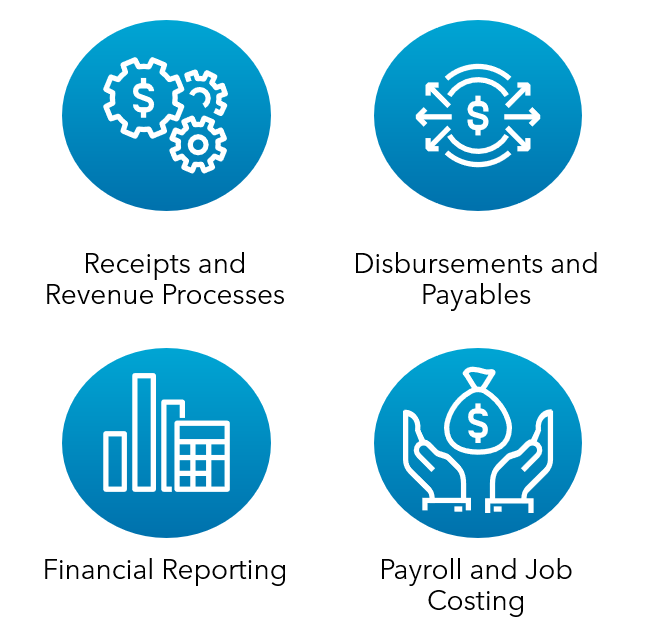
Receipts and Revenue Processes
Evaluate how the organization records contract billings, recognizes revenue and tracks deferred or unbilled amounts. Weaknesses in these areas can create material misstatements in financial statements and affect earn-out calculations post-acquisition.
Disbursements and Payables
Review vendor onboarding, invoice approval, payment authorization and procurement regulation compliance. Inefficient or non-compliant disbursement practices can result in cost allowability disputes and cash flow issues.
Financial Reporting
Assess internal management reporting and external financial statement preparation. The goal is to issue reports that are timely, accurate and align with contract type requirements.
Payroll and Job Costing
Examine payroll processing, labor charging practices and job cost allocation. Accurate labor distribution supports proper billing, indirect rate calculation and labor category requirements compliance.
Who Should Be Involved in a Business Process Review?
A business process review works best when it doesn’t occur in a vacuum. Collect input from the process owners who execute the day-to-day tasks. They can tell you what’s really happening—not just what’s written in a policy manual.
From there, get input from control owners. These individuals are responsible for monitoring compliance, spotting risks and ensuring safeguards work.
Finally, senior management and owners play a critical role by setting the strategic direction, allocating resources and ultimately deciding which improvements to prioritize.
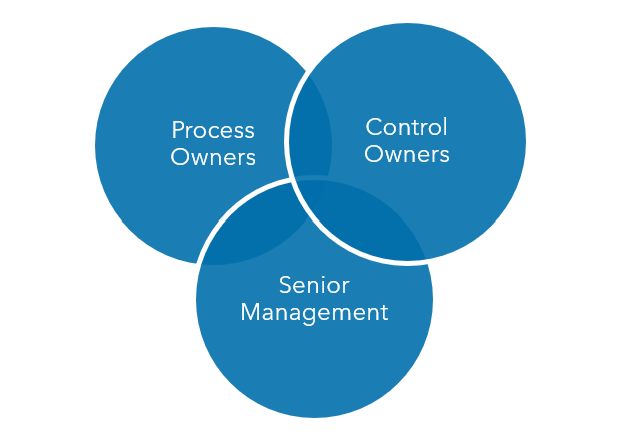
When all three groups work together, you get a realistic, actionable view of where processes stand and how to make them better.
What Happens in the Review?
A well-structured business process review identifies risks, closes compliance gaps and improves operational efficiency.
Interview Key Process Owners
Meet with individuals directly responsible for critical workflows, such as billing, procurement, payroll and reporting, to clarify how processes operate.
Document Processes
Map out each process in detail, outlining inputs, outputs, responsible parties and system touchpoints. This documentation helps identify dependencies, redundancies and bottlenecks across the organization.
Identify Controls and Control Gaps
Evaluate existing preventative and detective controls for effectiveness. Note any weaknesses or missing controls.
Create New Policies as Needed
Develop new policies and update existing policies to align with current regulatory requirements and integration needs across merged entities.
Report on Opportunities for Improvement
Summarize findings for senior management to highlight risks and compliance concerns. Point out opportunities for automation and cost savings. Prioritize recommendations to guide remediation and support informed decision-making during the M&A transition.

What Happens After a Business Process Review is Completed?
After the review, leadership should receive a customized roadmap to boost operational performance and reduce risk. This includes targeted process improvements, a clear breakdown of current vulnerabilities and smart controls to help prevent fraud, financial misstatements and costly errors.
Process Strength Translates into Deal Value
Reviewing and optimizing business processes before, during and after an acquisition can strengthen compliance, improve operational efficiency and enhance your competitive positioning in the marketplace. The result will be a more resilient organization.
To ensure your organization is prepared for its next transaction, contact your Warren Averett advisor.