
7 KPIs to Improve Profitability and Efficiency in Your Brewery

Measuring a company’s financial health is an important exercise for any business to go through, and breweries are no exception.
By using key performance indicators (KPIs) to measure your brewery’s past performance and your performance compared to the industry at large, you can see what you’re doing well and what can be improved.
Below are seven KPIs that can help you see where you stand today so you can grow your brewery’s value into the future.
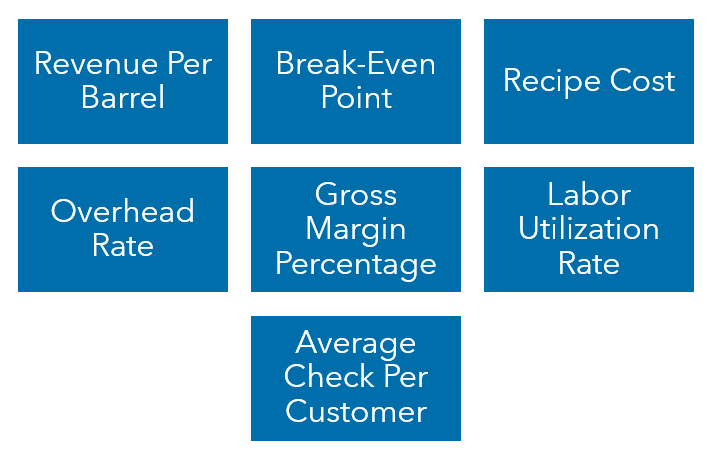
1. Revenue Per Barrel
The barrel is a common unit of measurement for a brewery, so it’s natural that industry KPIs have developed around it.
Revenue per barrel allows a brewery to see how much money is actually being generated per barrel of beer sold. This is a useful metric that can help you compare your brewery’s revenue generation to that of your peers.
Similar calculations can be used for other financial considerations, such as COGS per barrel, gross margin per barrel, labor per barrel and net income per barrel.
Calculation: Revenue / Barrels sold
2. Break-Even Point
Breweries have a lot of fixed costs to manage—from building and equipment rental fees to loan payments. Cash is often tight in this environment, so it’s important to understand your break-even point.
Break-even point is simply when revenues equal expenses. Any additional revenue at this point, while subject to variable costs, will be building your bottom line.
Understanding this number is particularly useful in start-up and expansion phases because it indicates how much cash you need to generate and whether you’ll need credit to cover any shortfalls.
Calculation: Fixed costs / (Sales price per unit – Variable costs per unit)
3. Recipe Cost
Understanding the theoretical cost to produce a batch of beer is vital to comparing actual production costs and results. Comparing the overall typical cost to produce a specific batch with the selling price of that batch can help you make the most informed decisions about your production and related profit.
For example, a 200-barrel batch of IPA uses a certain amount of raw materials to produce. Some amount of labor goes into producing this batch, and packaging material must be used to get this batch to its final sellable state.
If you consider your recipe cost to produce this batch of beer, how close is it to the selling price? If you aren’t seeing much profit, should this product even be produced, or can any of these inputs be manipulated to get the cost to where it should be? Are you paying too much for raw materials or is more labor is going into a batch than you expected?
Calculation: Extended Cost of Ingredients [total recipe quantity * unit cost (average cost or last purchase price)]
4. Overhead Rate
While raw materials and labor costs are simple enough to measure, they aren’t the only costs you should consider. Overhead can be thought of as all indirect costs other than raw materials and labor that are involved in the production process—like electricity, water, supplies and depreciation on equipment. To understand your true cost, these overhead factors must be considered.
The simplest way to track this is by taking estimated overhead for the year and dividing it by estimated barrels of production for the year. This is your estimated overhead cost per barrel of beer produced and can be folded into your raw materials and labor to help you understand where you truly stand on costs.
Calculation: Total estimated overhead / total estimated barrels of production
5. Gross Margin Percentage
Gross margin percentage is an indicator that measures the profitability of your products. If your gross margin is falling, it can indicate an increase in raw materials costs or inefficiency in production.
While gross margin percentage can be used for the business as a whole, it’s also a useful KPI when looking at the profitability of specific products, brands and beer types.
Calculation: Gross Profit (Revenue-COGS) / Revenue
6. Labor Utilization Rate
Efficiency KPIs can be just as useful as financial KPIs. The labor utilization rate allows a brewery to see how much time an employee spends on production, a revenue generating activity, compared to other activities.
Knowing your labor utilization rate can help to identify underutilized employees and help allocate the total workload while ensuring that the majority of labor hours are spent on production.
Calculation: Total number of production labor hours / total number of labor hours
7. Average Check per Customer
Most breweries have one or more taprooms. The margins on retail sales to customers can be much greater than distribution sales, so this is a KPI worth focusing on.
Increasing the average check size per customer can be done through offering promotions, creating loyalty programs, increasing your product offering, adding a limited-release beer or offering food.
Calculation : Total customer receipts / total customers served
Learn More about Measuring Your Brewery’s Financial Performance
These seven KPIs are just scratching the surface.
Identify all of the KPIs that are most relevant to your brewery and begin measuring them consistently with a proactive mindset. It’s important to develop an internal standard to compare your periodic KPIs to, but it’s equally important to set goals of where you’d like for your KPIs to be so you can clearly track your progress and make continual improvements to your business.
Consider industry standards and benchmarking for the most robust measurement of your brewery’s financial performance.
If you’d like to learn more about leveraging your financial data and KPIs to improve your brewery’s profitability and efficiency, contact your Warren Averett advisor directly, or ask one of our brewery advisors to reach out to you.