
What Should Go in Your Nonprofit Audit RFP?

Choosing the right audit firm for your nonprofit depends largely on the questions you ask up front. Some organizations select their audit firm through direct conversations, exploratory discussions or informal interviews.
For many others, the chosen path is the request for proposal (RFP).
For nonprofit organizations that do choose to send RFPs as a way to select an audit firm, the specific questions asked within play a decisive role in the outcome (before the first firm ever responds).
Many nonprofit audit RFPs result in proposals that look polished but are difficult to compare, leaving committees to sort through a maze of follow‑up questions, assumptions and gaps.
While your RFP won’t change a firm’s qualifications, asking certain questions can make your evaluation easier. This guide outlines practical questions nonprofits can use to get more useful information, see meaningful differences in firms and make auditor decisions with confidence.
Defining the Purpose of Your Nonprofit’s Audit RFP
Before you begin formulating your nonprofit’s RFP, it’s important to first define your purpose for issuing the RFP.
Are you actively looking to make a switch in providers? Do you want a market check on fees and expectations? What matters most to you and your Board in a firm? Defining your purpose internally will help you formulate your RFP, align Board and staff expectations and prioritize what to evaluate when assessing bids.
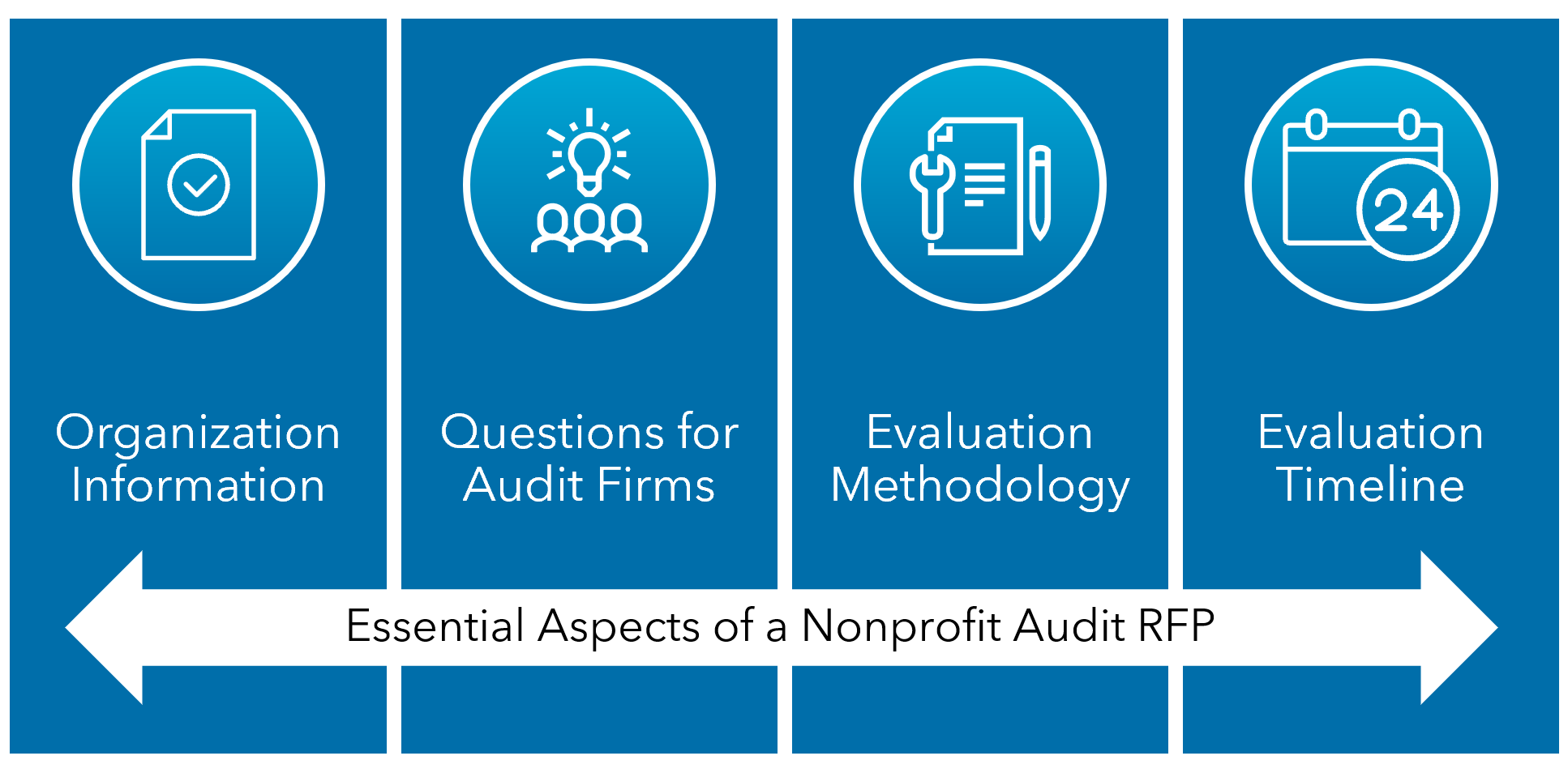
Information to Include About Your Organization
Providing background information and context within the RFP itself will help eliminate the need for back-and-forth Q&A with audit firms. Things you could include:
- Mission and programs, to help align expertise with grants
- Most recent copy of your audited financial statements and Form 990
- Fiscal year end (to assist with the development of an audit timeline)
- Types of revenue and funding sources
- Related entities, like a separate foundation
- Whether a Single Audit applies, in order to factor in timing, expertise and budget
Questions for Audit Firms
1. Overview
What to ask: Provide a firm overview, including size, office locations, years in operation and service lines that are relevant to nonprofits of our size and funding profile.
Why it matters: A straightforward overview helps your audit committee understand how the firm is structured and how it would support your organization. When the basics are laid out clearly, it’s easier to assess at a glance whether a firm has the right capacity and background for your audit.
What to look for in responses: Responses are most useful when they stick to facts and connect the firm’s capabilities to your needs. Generic brochure language is a red flag.
2. Nonprofit Expertise
What to ask: Summarize your nonprofit audit experience from the past three years, including the number of nonprofit audits performed, typical budget sizes served and common funders/regulators involved. List any other qualifications your firm has for nonprofit audit engagements. Provide a list of nonprofit clients you serve that are similar to our organization.
Why it matters: Asking for recent, quantifiable and comparable experience in your RFP filters out generic responses and allows you to get a realistic view of a firm’s learning curve. Would your audit be a routine engagement for this firm? Would it require significant ramp-up, additional review layers, or increased staff turnover risk? Time‑boxing the request (e.g., “past three years”) keeps proposals relevant to current standards, technology and staffing models, which makes scheduling and deliverables more predictable.
What to look for in responses: Experience means most when it reflects your organization’s size, funding structure, and compliance requirements. Be wary of responses that rely on examples from other industries.
3. Audit Timeline and Approach
What to ask: Describe your audit methodology, including the work plan, communication methods, whether you prefer an on-site, remote or hybrid environment, a list of client‑prepared items, and an engagement timeline.
Why it matters: This section in nonprofit audit RFPs tends to be prone to some of the most boilerplate answers, but an audit approach should feel personal. Asking this question gives your committee a realistic picture of how the audit will unfold. Fewer surprises during planning make it easier for nonprofit teams to manage the audit alongside daily operations.
What to look for in responses: A defined audit sequence, expected timing and role responsibilities help your team anticipate what the audit will require. Audit procedures paired with a representative request list provide insight into information needs and workload expectations.
Timelines should account for fieldwork and draft deliverables with adequate buffer before Board or funder deadlines. Vague references to “standard timing” might indicate that the firm hasn’t invested enough time into planning.
4. Staffing
What to ask: List the professionals who would be assigned to our audit. Provide short biographies, including years of nonprofit audit experience, years with your firm, expected time commitment to our audit, and two recent (last 24 months) nonprofit engagements similar to ours.
Why it matters: Who does the work (and how leaders stay involved) shapes an audit. Having a consistent team suggests fewer staffing changes in the middle of your engagement. Recent experience with similar nonprofits also signals familiarity with reporting requirements, grantor expectations and audit schedules.
What to look for in responses: Seeing the engagement team roster (specifically named staff and not theoretical staff), their respective responsibilities, and how partners and managers stay involved indicates how the audit will be staffed. Bios should demonstrate nonprofit familiarity, not just credentials. Firms should explain who leads fieldwork and who handles the technical review.
5. Scope of Services and Deliverables
What to ask: Confirm the engagement scope. List the deliverables you will provide (e.g., audited GAAP financial statements with notes, a management letter with control and process recommendations, presentation of results to the Board or Audit Committee, etc.), provide example reports, and confirm your ability to follow our submission format and timeline.
Why it matters: Confirming expectations helps both your nonprofit and the audit firms understand what needs to be delivered and when. This also helps reduce any misunderstandings or surprises that could impact timelines.
What to look for in responses: Each deliverable should be identified explicitly so there is no uncertainty about what’s included in the engagement.
6. Ongoing Support and Advisory Services
What to ask: Outline the advisory and support services your firm provides throughout the year.
Why it matters: Aside from the deliverables, it’s important to understand what ongoing support includes.
What kind of access will you have to your advisors? What is the firm’s response time for client communications? What educational resources do they offer? If you have a question, does asking it fall within the engagement? What additional services could the firm offer if a need arises? And what services would be an additional fee?
What to look for in responses: Pay special attention to response time commitments, a clear description of what advisory access includes and examples of practical resources available. Look for reasonable boundaries so you know when a question is covered by the engagement and when it requires separate scoping or fees.
7. Fees
What to ask: Provide multi-year fees for the audit. List hourly rates by role; state what is included; identify out‑of‑scope services and rates; and disclose any travel or other expenses.
Why it matters: Pricing transparency helps your audit committee understand both the cost of the audit and the assumptions behind it. Comparing fees and hours among firms can help you see true pricing differences. This is where you’ll really be able to tell if firms have different interpretations of your scope.
What to look for in responses: In the nonprofit world, unclear fees create unnecessary risk. Be sure this section is straightforward, and it’s easy understand what’s included.
8. Independence, Legal and Regulatory Disclosures
What to ask: Disclose any relationships, services or circumstances that could impair or appear to impair independence with respect to our organization. Also summarize any current or recent litigation, regulatory inquiries, investigations or peer review findings that may affect audit quality or service continuity.
Why it matters: Independence and regulatory standing directly affect the reliability of your audit. Asking for clear disclosures in your nonprofit audit RFP can help you understand whether a firm can meet professional requirements.
What to look for in responses: Firms should clearly describe any issues, using specific, straightforward language. When issues are identified, responses should explain their current status and the steps they’ve taken to remediate them. Firms should also explain how they manage independence and respond to peer review findings.
Disclosure doesn’t have to be an automatic disqualification. The end goal is transparency over perfection.
9. Client References
What to ask: List references from comparable nonprofits (similar in budget size, service mix, funder profile and audit scope) along with contact information and a description of the work performed.
Why it matters: References give an outside perspective on day‑to‑day interactions, responsiveness and how the firm handles deadlines. Organizations with similar funding and oversight demands can speak directly to expectations around board reporting, grantor communication and the audit timeline. This personal feedback can help your committee understand what the working relationship may look like beyond the proposal. References give you valuable qualitative feedback and can help sway a decision when two firms are close in evaluation scores.
What to look for in responses: References listed should be similar to your own nonprofit’s profile.
10. People Practices and Service Standards (Internal Alignment)
What to ask: Explain how you recruit, train and evaluate professionals who work on nonprofit audits, and describe the skills and experience that guide your nonprofit engagements.
Why it matters: Defined training plans can cut down on ramp-up time and errors. For nonprofits managing governance calendars and funder requirements, asking about that predictability in your RFP supports smoother planning and fewer adjustments.
What to look for in responses: Descriptions of onboarding plans and continuing education programs that are specific to nonprofit work can indicate that the firm truly emphasizes and enforces strong nonprofit service. Strong responses name the service standards they track and explain how those standards are monitored and reinforced.
11. Community Commitment
What to ask: Summarize your firm’s involvement with nonprofits in your community and how that commitment shows up in your work with nonprofits.
Why it matters: If a firm has boots-on-the-ground volunteer experience with nonprofits, that can show that the firm understands your organization’s operations and needs comprehensively, not just at audit time.
What to look for in responses: Responses should reference measurable involvement in the community or in specific nonprofit initiatives, illustrating an ongoing commitment rather than generic support.
How Proposals Will Be Evaluated
Providing your evaluation criteria within your nonprofit’s audit RFP will help ensure that the responding accounting firms give weight to what you find most valuable. The scoring system should be developed with your C-Suite and Board of Directors, so that everyone is aligned.
Your evaluation methodology could be a scoring table with point values for each category in the RFP, and you may even need tiebreaker scenarios to help assist your Audit Committee (e.g., the final decision will come down to references or to which firm aligns most closely to your values).
Your Nonprofit Audit RFP Evaluation Timeline
In addition to how you will select your audit firm, your RFP should include a rough timeline of your evaluation and decision, including:
- Deadline for Q&A
- Deadline for accepting responses
- Your evaluation period
- Notifications for shortlist firms if you plan to have final oral presentations
- Oral presentation dates, if applicable
- Final decision date
Your decision timeline should consider plenty of turnaround time for your Board and/or Committee to evaluate proposals carefully and choose the right firm, coinciding with where it fits in your overall audit timeline for the fiscal year.
Learn More About Setting Your Nonprofit Up for a Successful Audit
With the right questions in your nonprofit audit RFP, the proposals you receive can be more aligned with the way your nonprofit works. To learn more, contact your Warren Averett advisor directly, or ask a member of our team to reach out to you.