
New Comparability Profit-Sharing Plans: What They Are and How They Work

A common goal for small business owners is to maximize owner contributions to retirement accounts. One way to accomplish that goal is a new comparability profit-sharing plan.
What are New Comparability Profit-Sharing Plans?
New comparability profit-sharing plans are qualified defined contribution plans that allow employers to customize contributions for different groups of employees or for individual employees.
Resource: Compare your options with this retirement plan comparison chart.
Unlike traditional profit-sharing plans, these new comparability profit-sharing plans can have a tiered contribution structure, enabling employers to allocate contributions in a way that can favor certain groups of employees—typically older or higher-paid employees—while still offering other participants a healthy employer contribution.

Who Can Sponsor These Plans?
Any business, regardless of size, can sponsor a new comparability profit-sharing plan.
This type of plan is particularly attractive to companies that have a diverse workforce in terms of age and compensation and wish to provide a more substantial benefit to certain employees, such as owners or key executives.
New comparability profit-sharing plans may not be the best fit for companies with large fluctuations in their workforce. Large changes in workforce size or demographics can impact an employer’s funding costs and the ability to achieve funding objectives.
How Do New Comparability Profit-Sharing Plans Work?
New comparability profit-sharing plans can be stand-alone plans, or they can be added to a 401(k)/Safe Harbor 401(k).
Unlike 401(k) plans, employees do not contribute to new comparability profit-sharing plans; these plans are funded solely by employer contributions. The best way to explain how new comparability profit-sharing plans work is to consider an example.
Say you have a medical practice with one physician owner and four employees. A new comparability profit-sharing plan would allow the company to divide employees into two or more groups based on objective standards (i.e., the owner being in one group and the employees being in another group).
The employer can contribute up to 25% of the eligible employees’ compensation, and an IRS-approved formula permits the company to allocate a greater percentage of profit-sharing contributions to one group (i.e., the owner) versus the other group (i.e., the employees). For example, the plan can allocate 20% of compensation to the owner and 5% to the other employees.
The table below illustrates how such a plan might compare to a traditional 401(k) plan that gives all employees a contribution of 5% of their eligible compensation.

What are the advantages of offering a new comparability profit-sharing plan?
New comparability profit-sharing plans come with many benefits for an employer.
The greatest advantage is that it gives owners and other highly compensated employees a larger share of the annual employer contribution than non-highly compensated employees but is still considered non-discriminatory under the law.
Contributions are tax-deductible for the business, and employers can adjust contributions annually based on profitability—or contributions can be stopped altogether.
New comparability profit-sharing plans can be used by companies to effectively motivate and retain key employees by allocating higher contributions to them.
What are the contribution limits for these plans?
Employers can make discretionary contributions of up to 25% of eligible employee compensation. Individual eligible employee compensation is limited to $345,000 (indexed for inflation). For 2023, individual total contributions cannot exceed $66,000 ($73,500 if 50 or older if part of the contribution is 401(k) deferral). For 2024, the maximum contributions are $69,000 ($76,500 if 50 or older if part of the contribution is 401(k) deferral).
What are the reporting requirements for a new comparability profit-sharing plan?
New comparability profit-sharing plans require annual reporting to the IRS using Form 5500.
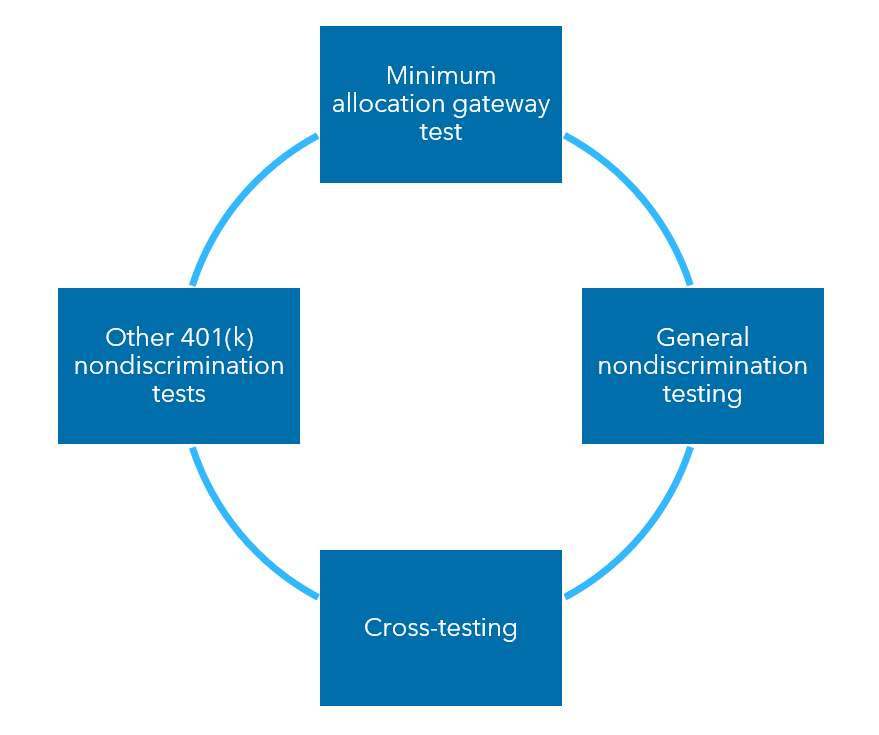
Additionally, non-discrimination testing must be performed annually. Those tests include:
- Minimum allocation gateway test
- General nondiscrimination testing
- Cross-testing
- Other 401(k) nondiscrimination tests
Performing these tests can be complex, so it’s a good idea to work with your tax advisor or plan administrator to complete testing before making funding contributions to ensure allocations are nondiscriminatory.
What is the timeframe for managing this plan?
Employers can establish a new comparability profit-sharing plan any time prior to tax filing, and contributions can be made up until the business’s tax-filing deadline, including extensions.
Learn More About New Comparability Profit-Sharing Plans
New comparability profit-sharing plans offer a flexible and tax-efficient way for business owners to maximize their retirement savings while contributing to their employees’ accounts.
However, while they do offer significant advantages, particularly in terms of contribution flexibility and tax benefits, they also come with increased complexity and higher administrative costs—so, it’s important to seriously consider if this type of plan is truly a fit for your organization.
If you have questions about new comparability profit-sharing plans or want to know which type of retirement plan may be the best fit for your company, contact Warren Averett Benefit Consultants.
