
6 Common Manufacturing Accounting Issues (and How To Avoid Them)

For manufacturers, accounting is more than just financial recordkeeping—it’s a critical component of successful operations.
Having the right manufacturing accounting processes in place can go a long way to help manufacturers conquer the industry’s unique financial challenges. On the other hand, accounting oversights can lead to waste, distorted financial statements, misinformed decision-making, potential regulatory non-compliance and lost profits.
Reviewing your accounting processes with a high attention to detail can make the difference between opportunity and loss. That’s why we’ve listed the six most common manufacturing accounting oversights here—plus the best practices you can employ to avoid them.
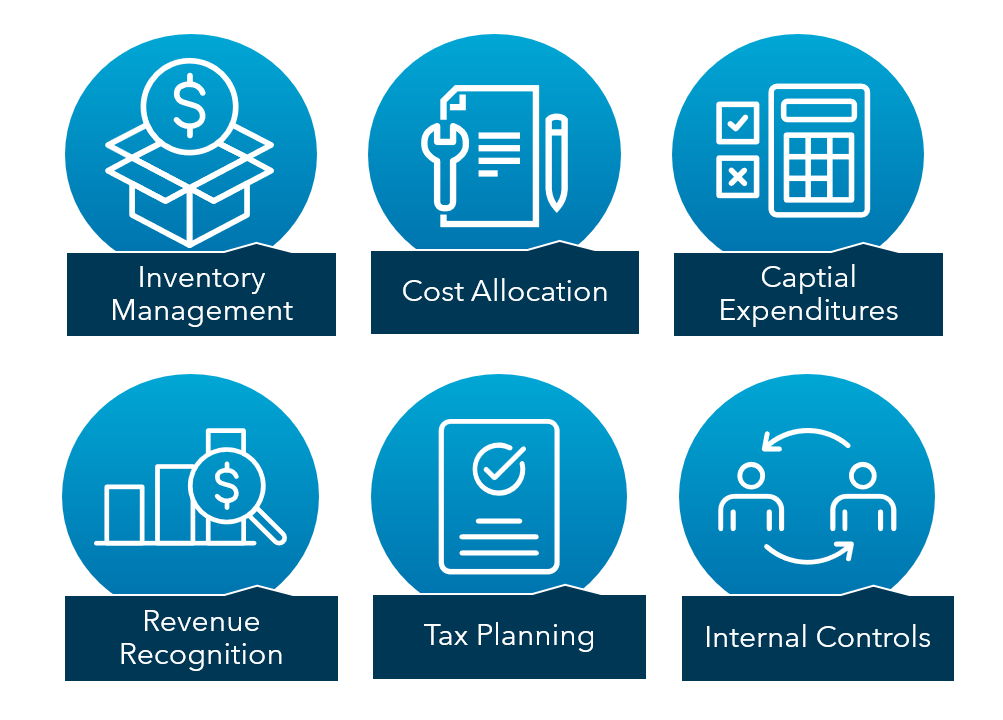
The Most Common Manufacturing Accounting Oversights and Their Remedies
1. Inventory Valuation and Management
Oversight: Delays in data entry, manual counting errors and unrecorded inventory movements distort your cost of goods sold (COGS) and gross margins. This obstructs accurate production planning and financial forecasting, leading to resource misallocation, inefficient schedules and loss of competitive advantage.
Best Practice: Implement an advanced perpetual inventory system that integrates with your enterprise resource planning (ERP) systems. Perpetual inventory systems typically require advanced inventory management software, but their scalability and data visibility make them ideal for manufacturers with large, complex inventory valuation and management challenges.
These tools support real-time tracking of inventory levels, movements and usage so you can ensure your inventory records (and your overall manufacturing accounting records) are always up to date.
2. Cost Allocation
Oversight: Especially in automated, high-tech production environments, overhead costs can easily be allocated incorrectly. Traditional costing methods fail to capture all of the production expenses in sophisticated manufacturing environments, leading to misallocated overhead.
When indirect costs are uniformly spread across all products without considering the specific resources each product consumes, this results in misleading product cost data, which distorts profitability analysis and strategic decisions, potentially eroding your competitive positioning.

Best Practice: Ensure direct and indirect expenses are properly identified and classified in your manufacturing accounting system.
Establish clear guidelines for what constitutes direct versus indirect costs, and regularly review these classifications to ensure accuracy. Integrate these practices into your ERP systems. Maintaining consistent and accurate cost allocation helps ensure your financial data reflects the true cost structure of your production processes.
3. Capital Expenditures
Oversight: In capital-intensive manufacturing businesses, the line between capital expenditures (CapEx) and operating expenses (OpEx) can become blurred. It’s not uncommon for manufacturers to mistakenly misclassify repairs, upgrades or de-minimis equipment and supplies on the balance sheet.
These misclassifications affect depreciation calculations (leading to inaccuracies in financial statements) and distort CapEx ratio calculations, (which help determine whether the company has enough capital to invest in CapEx).
Best Practice: Conduct a comprehensive analysis before making capital expenditures. This analysis should include evaluating the timing of the investment, considering whether an upgrade or replacement is necessary and ensuring all costs, including hidden or indirect ones, are accounted for.
Additionally, establish clear criteria for expected ROI, factoring in both short-term and long-term gains. Integrating these practices into your manufacturing accounting will help ensure that capital investments are strategically aligned with your business objectives, optimizing financial performance and supporting sustainable growth.
4. Revenue Recognition
Oversight: Revenue recognition can be particularly challenging in complex, multi-phase manufacturing contracts. Under Accounting Standards Codification (ASC) 606, Revenue from Contracts with Customers, manufacturers may be required to recognize revenue over specific contract terms rather than at a point in time, such as when the product is shipped.
Incorrect, premature or delayed revenue recognition leads to misstated revenue figures, which distort the company’s financial performance and cause cash flow discrepancies.
Improper revenue recognition can also expose the company to regulatory penalties and potential legal issues, undermine stakeholder confidence and impair the company’s ability to secure financing or outside investments.
Best Practice: Follow a framework to recognize revenue in your financial statements. ASC 606 provides five steps for recognizing revenue:
- Identify contracts with customers
- Identify performance obligations in the contracts
- Determine the transaction price
- Allocate the transaction price to the contract’s performance obligations
- Recognize revenue when you satisfy a performance obligation
Satisfying performance obligations can happen either at a specific moment or over a period of time. For complex manufacturing operations, revenue recognition software can help simplify the process by defining rules to ensure your organization complies with ASC 606.
5. Tax Compliance and Planning
Oversight: There are many tax credits available to manufacturers, and failing to identify and apply for available tax credits and incentives is a common oversight in manufacturing accounting. This is particularly true for payroll tax credits, which often must be applied for up front, and for R&D tax credits, which require manufacturers to meticulously document R&D activities to substantiate claims.
Overlooking tax credits and incentives means missing tax-saving opportunities, resulting in higher tax liabilities and reduced funds available for reinvestment in the business. Over time, these missed opportunities accumulate, creating a substantial financial impact that hampers growth and innovation.
Best Practice: To avoid missing out on valuable tax credits and incentives, work with an experienced tax professional who can help with proactive tax planning. Tax advisors stay informed about the various tax credits and incentives available and understand the specific requirements for each.
Your tax advisor may also recommend software to help identify eligible activities, manage documentation and streamline the application process for tax credits and incentives.
6. Internal Controls and Fraud Prevention
Oversight: In a highly automated manufacturing accounting process, management can overlook or inadequately design internal control systems.
Weak internal controls typically result from a lack of segregation of duties, inadequate access controls and a lack of proper reviews, such as oversight over vendor setup and payments. Often, these internal control weaknesses occur because automation creates a false sense of security.
Without sound internal controls, organizations face a heightened risk of fraud, theft and financial misstatements. Fraudulent activities may go undetected, leading to significant financial losses and misstatements, which can damage the company’s reputation, erode stakeholder trust and result in regulatory scrutiny.

Best Practice: Implement strong internal controls, including automated monitoring, internal audits and third-party reviews.
Automated internal controls are great at continuously tracking transactions and activities and flagging anomalies for further investigation. But providing oversight and conducting reviews of high-risk areas prone to fraud and errors is also important.
A dual approach ensures you promptly identify and address deficiencies, reducing the risk of fraud, theft and financial misstatements.
Continuously Improving Your Manufacturing Accounting Processes
Maintaining effective manufacturing accounting practices is essential to sustaining financial health and achieving long-term success. As the manufacturing industry evolves and as new challenges arise, continually look for opportunities to refine and improve your accounting processes.
To stay ahead of the curve, partner with experts who understand the ins and outs of manufacturing accounting. Connect with a Warren Averett advisor today to receive tailored guidance and support in optimizing your accounting systems and controls, helping you to mitigate risks and maximize your financial potential.