
The One Big Beautiful Bill Breakdown: Natural Disasters and Theft Losses
The One Big Beautiful Bill has expanded tax relief for casualty losses.
The Previous Tax Law
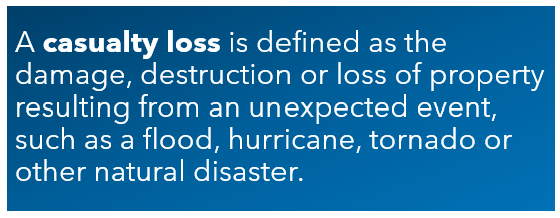
Under the Tax Cuts and Jobs Act (TJCA) that passed in 2017, casualty losses could only be taken if the loss occurred as a result of a presidentially declared disaster from 2018-2025. This significantly reduced the number of taxpayers that would have been able to claim a casualty or theft loss.
From 2018-2025, if a taxpayer was hit by a tornado or house fire that was not deemed a presidentially declared disaster, then there was no remedy via the tax code for the taxpayer to claim a casualty loss to try to recoup the loss. Additionally, under the TCJA, personal theft losses, such as computer scams or stolen jewelry, were no longer deductible.
There is an allowance to offset casualty gains with casualty losses that were not deemed a presidentially declared disaster.
New and Final Law Under the One Big Beautiful Bill
As part of the final One Big Beautiful Bill, a casualty loss will continue to only be deductible if it is due to a presidentially declared disaster, but the provision was expanded to include state declared disasters.
This will allow more taxpayers to be able to claim a casualty loss, since the governor of each state has the authority to declare a state disaster. The addition of the state declared disasters applies to taxable years beginning after December 31, 2025.
The bill also permanently extended the provision which limits casualty loss deductions to presidentially or state declared disasters. As a result, theft losses are no longer deductible as a casualty loss.
The One Big Beautiful bill does expand the definition of a qualified disaster by changing the date of enactment on the Taxpayer Certainty and Disaster Relief Act of 2020, amended by the Federal Disaster Relief Act of 2023, to the date of the One Big Beautiful Bill’s date of enactment. The “qualified” disaster designation allows taxpayers to add their casualty loss to the standard deduction and removes the 10% AGI limitation.
What It Means for You
Because the defining dates for a “qualified disaster” were extended, the California wildfires that occurred at the end of 2024 and early 2025, which were not originally included in the Federal Disaster Relief Act of 2023, are now eligible for tax relief.
It is imperative to consult the FEMA website to determine if a natural disaster in your area was deemed a presidentially or state declared disaster. Be sure to check your insurance documents to make sure you are fully covered for house fires, flooding, home burglary and lightning strikes, so that your loss will be mitigated by insurance recovery.
To learn more about how the One Big Beautiful Bill and these specific provisions may impact you, contact your Warren Averett advisor.
