
The One Big Beautiful Bill Breakdown: Qualified Production Property
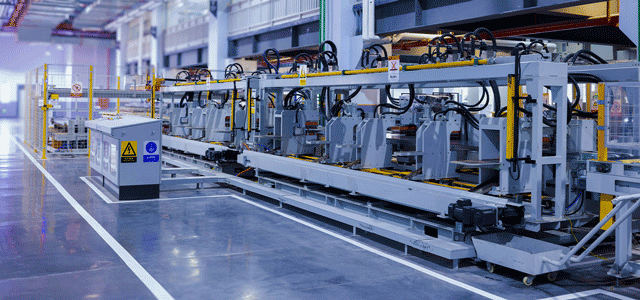
The One Big Beautiful Bill has introduced a new tax provision that will allow manufacturers to fully expense qualifying facilities.
The Previous Tax Law
Previously, manufacturing buildings were classified as nonresidential real property and were generally depreciated over 39 years.
New and Final Law Under the One Big Beautiful Bill
The One Big Beautiful Bill introduces Code Section 168(n), which coins the formal terms “qualified production property” and “qualified production activities,” which, for practical purposes, means “manufacturing.”

If you’re engaged in a qualified production activity—meaning you’re transforming materials or property into a product—then the new facility integral to that process may now be 100% expensed, similar to bonus depreciation.
Qualified production property includes newly constructed and certain existing non-residential real estate used in manufacturing, production or refining of tangible personal property within the United States.
It does not include any portion of nonresidential real property which is used for offices, administrative services or other functions unrelated to manufacturing, production or refining of tangible personal property. Taxpayers can elect 100% depreciation for qualified production property in the year it is placed in service.
To be eligible, the facility must be placed in service before January 1, 2031, and construction must begin after January 19, 2025, and before January 1, 2029. Just like with traditional bonus depreciation, the IRS will look at the date on which the taxpayer enters into a written binding contract.
It’s important to note that the food and beverage industry is specifically carved out from this provision. Even though restaurants transform ingredients into meals, if the food is sold in the same retail establishment, the facility doesn’t qualify.
It’s also important to mention that if you own the facility and lease it to a manufacturer, the lessor will not qualify for the 100% depreciation. The benefit doesn’t transfer just because your tenant is doing the manufacturing. The original use of the manufacturing facility must begin with the taxpayer.
Generally, the facility should be new construction. However, there is a special rule that will allow existing property to qualify for the deduction in specific circumstances. In these circumstances, the property must not have been used in a qualified production activity any time during the period beginning on January 1, 2021, and ending May 12, 2025. There are also other limitations in place such as property acquired from a related party.
If you take the 100% depreciation and then stop the qualified production activity within 10 years, you’ll have to recapture that depreciation as ordinary income. So, using this tax strategy is a long-term commitment. As this is a new provision, we expect more guidance and information over the coming months.
What It Means for You
The addition of Code Section 168(n) encourages capital investment in manufacturing and supply chain infrastructure, and the provision is clearly designed to incentivize manufacturers to build plants within the U.S. If your business is considering facility upgrades or new construction, you may benefit from aligning your timelines with the eligibility window.
However, if you’re considering this strategy, talk to a tax advisor first to make sure you meet all the requirements and avoid any pitfalls.
To learn more about how the One Big Beautiful Bill and this specific provision may impact you, contact your Warren Averett advisor.
