
4 New ESOP Rules and Regulations Under the SECURE 2.0 Act

The Setting Every Community Up for Retirement Enhancement (SECURE) Act introduced significant changes to retirement savings rules in 2019. Now, SECURE 2.0 (which became law in late 2022) brings more modifications—especially for Employee Stock Ownership Plans (ESOPs).
Many provisions of SECURE 2.0 involve expanding and increasing retirement savings in 401(k) plans—especially for low-income and part-time employees. However, it also includes many provisions related to ESOPs.
Here’s a look at four important changes to ESOP rules and regulations.
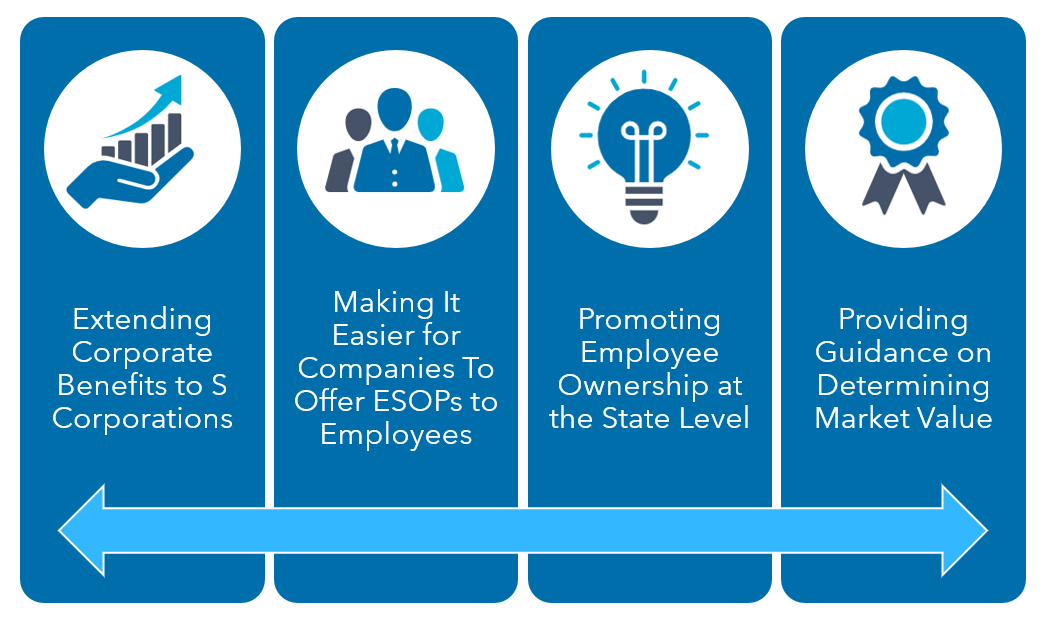
Extending Certain Corporate Shareholder Deferral Benefits to S Corporation Shareholders
Under current law, individual shareholders in a non-publicly traded C corporation sponsoring an ESOP can opt to defer the recognition of gain from the sale of stock to the ESOP as long as the seller reinvests the proceeds into qualified replacement property, either three months prior to the sale or within 12 months after the sale.
Qualified replacement property can include stock or other securities issued by a U.S. corporation. After the sale, the ESOP must own 30% or more of the employer corporation’s issued and outstanding stock.
For years, proponents have urged lawmakers to extend this tax treatment to owners of S corporations. SECURE 2.0 provides for a limited tax deferral benefit to S corporation owners. Under this new provision, S corporation shareholders are allowed a 10% gain deferral.

For example, if an owner has $1,000,000 in gains, the owner could defer $100,000. This change is effective for deferrals made after December 31, 2027.
Making It Easier for Companies To Offer ESOPs to Employees
ESOP companies listed on stock exchanges don’t have to have an annual valuation.
IRS Notice 2011-19 defines when employer securities held by an ESOP are a “publicly traded employer security” and “readily tradeable on an established securities market.”
In particular, it allows some non-exchange traded securities to qualify as “publicly traded employer securities” as long as the security meets certain rules:
- Is subject to price quotations by at least four dealers on an SEC-regulated interdealer quotation system
- Is not a penny stock
- Is not issued by a shell company
- Has a public float of at least 10% of outstanding shares
Issuers must publish annual audited financial statements for securities issued by domestic corporations. Securities issued by foreign corporations are subject to additional reporting and depository requirements.
The SECURE 2.0 Act updates the definition to allow highly regulated companies with liquid securities quoted on non-exchange markets to treat the stock as “public” for ESOP purposes. While few ESOPs fall into this category, the change is beneficial for community banks with shares traded over the counter because it makes it easier for them to offer ESOPs to employees.
shares traded over the counter because it makes it easier for them to offer ESOPs to employees.
This change is effective for plan years beginning after December 31, 2027.
Promoting Employee Ownership at the State Level
The SECURE 2.0 Act contains the Worker Ownership Readiness and Knowledge (WORK) Act, which requires the Department of Labor to establish an Employee Ownership Incentive to promote employee ownership at the state level.

This program will be funded initially with $4 million in the 2025 fiscal year, gradually increasing to $16 million by the 2029 fiscal year. These funds will go toward state-level grants for educating business owners and employees about the benefits of ESOPs.
Funds can also be used to create a databank of legal, financial and technical resources, as well as a network of employee-owned companies.
This is the first federal grant program dedicated specifically to promoting ESOPs.
Providing Guidance on Determining Market Value
The WORK Act also requires the Department of Labor to develop regulatory guidance on determining the good faith fair market value for shares of a business acquired by an ESOP.
This directive is meant to fill a regulatory gap in ERISA 408(e), which exempts an ESOP’s purchase of its sponsoring company stock from ERISA’s prohibited transaction rules, as long as the ESOP does not pay more than “adequate consideration” for the stock.

ERISA defines “adequate consideration” as: “Fair market value of the assets as determined in good faith by the trustee or named fiduciary pursuant to the terms of the plan and in accordance with regulations promulgated by the Secretary.”
However, the Secretary of Labor has not provided rules about what defines a good faith fair market value since ERISA became law in 1974.
Learn More About SECURE 2.0’s Impact on ESOP Rules and Regulations
We will keep an eye out for further developments on ESOP rules and regulations.
In the meantime, if you would like to discuss how an ESOP can help accomplish your goals and benefit your company or employees or how these changes might impact an existing plan, we can help.
Please contact your Warren Averett advisor or ask a member of our team to reach out to you.