
3 Things All Established Companies Should Evaluate

Entrepreneurs pull out all the stops to launch a startup and to develop it into a stable, successful organization. But, after the whirlwind of bootstrapping and growth, most successful companies inevitably find themselves operating in an established industry with a well-known product and consistent customers.
And they naturally see growth start to slow.
Finding your business in a season of stability isn’t a bad thing at all—but it does mean that it’s time to adjust your approach. The same tactics that propelled your business through inception and expansion are simply not the same tactics that you should use for steady success in the long term.
The best way to move forward is to rely on your data from the past to project a positive path for the future. Most likely, your company has a long history of valuable data that you can benchmark against your current activity. The key is to be sure you’re actually measuring the right things.
Here, we’ve outlined the three broad areas that all established companies should be actively evaluating (and the specific KPIs to track) in order to maintain success into the future.
1. Productivity
When your company becomes established, it’s important to ensure you’re operating as efficiently and productively as possible.
Companies in the start-up and expansion phases are most often concerned about increasing production to meet demand. In many cases, this means that growth is prioritized over efficiency. But as a stable and mature organization, you need to continuously find ways to cut costs, increase productivity and become more efficient in your processes.
With the right data and analysis, you can eliminate unnecessary steps in a process or even replace manual steps with automation, allowing more time for you and your team to focus on even more valuable activities.
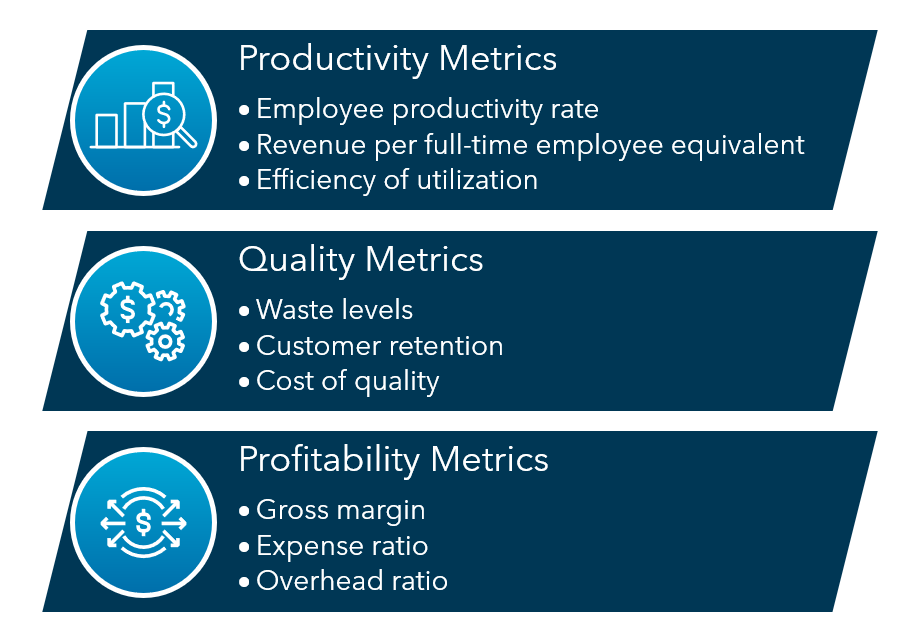
Some of the most important data points to track your operational efficiencies include:
- Employee productivity rate
- Revenue per full-time employee equivalent
- Efficiency of utilization
2. Quality
If it isn’t broken, should you fix it?
Producing a particular product or services is what made your business successful—but that doesn’t mean that you shouldn’t continue to find ways to improve it.
One of the best ways for an established company to maintain a competitive advantage is not necessarily to upend what’s made your product or service successful, but to ensure that quality standards are good enough to retain customers.
Stay innovative and explore how new technology can improve help you maintain quality and enhance your existing customers’ experience. You may still be producing the same type of product or service, but new advancements may offer opportunities to increase the value of what you offer without altering what makes your organization unique.
To track your organization’s quality over time, consider measuring:
- Waste levels (materials sent into production that are not part of a finished product)
- Customer retention
- Cost of quality (costs resulting from internal failures and costs associated with efforts spent reviewing or inspecting)
3. Profitability
Many successful, established organizations find themselves in a stable financial position, unlike most organizations in the startup and growth stages that are constantly striving to maintain a healthy cash flow. But that doesn’t mean that financial analysis can take a backseat.
To maintain healthy profitability, mature companies need to focus on proactively identifying negative trends (such as cost creep) through routine financial analysis so that you can address any concerns well in advance of a problem.
Because of this stability, many companies are also generating excess cash that isn’t essential for immediate reinvestment. This presents an opportunity for a business owner to diversify your personal wealth because the risk of having all of your assets tied up in a single enterprise is reduced. However, it’s crucial to ensure that any funds withdrawn don’t harm the company’s operations.
Metrics to track in order to effectively understand the organization’s profitability include:
- Gross margin
- Expense ratio
- Overhead ratio
Learn More about Leading an Established Company to Success
For successful companies, focusing more on stability than growth and expansion can be a challenging shift, but it’s an important one for the long-term viability of the organization.
These areas and their associated metrics can help your organization make informed decisions for the road ahead. Can you continue to operate effectively and achieve the desired return given the risks involved? Should you, as a business owner, consider an exit soon? Is your company effectively adjusting to market challenges?
Having the right data and measuring the right KPIs can go a long way towards helping you answer these questions and navigate all of the challenges your company may face.
If you’d like to learn more about what success looks like for an established organization, contact your Warren Averett advisor directly, or ask a member of our team to reach out to you.