
6 Tax Planning Items Every Business Should Consider in Year-End Tax Planning

Proactive tax planning can help your business increase after-tax cash flow and better navigate changes in tax law. As another calendar year comes to a close, are you taking a proactive approach to optimize your business’s tax position and minimize tax liabilities?
Areas to Consider for Year-End Tax Planning in 2023
Year-end tax planning is critical for businesses to optimize their tax positions and minimize tax liabilities. By considering the changes in tax law and IRS guidance that emerge each year, you can make informed decisions that will benefit your business.
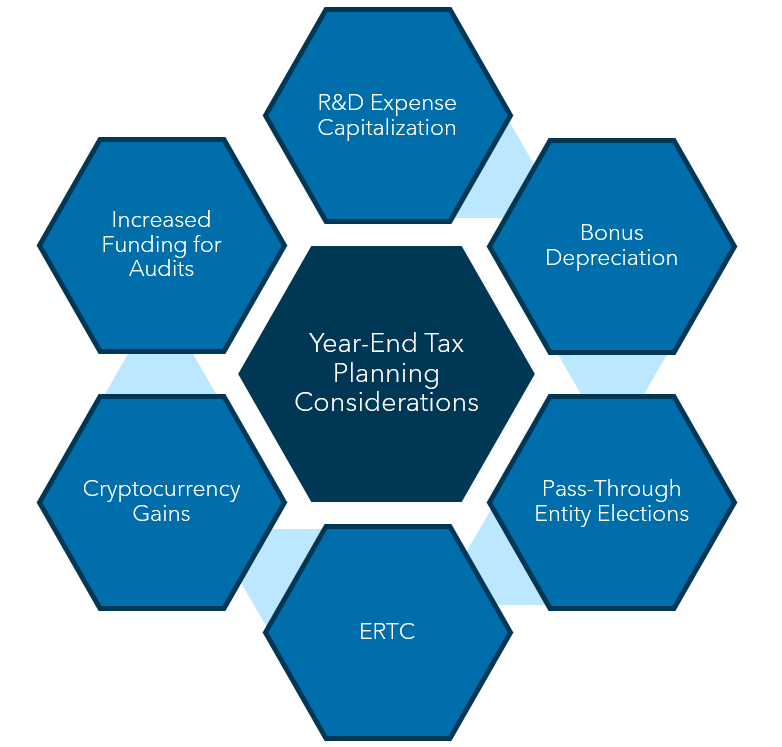
This article explores six key considerations every business owner should consider when conducting year-end tax planning in 2023.
Research and Development Compliance
Section 174 of the Internal Revenue Code (IRC) addresses how businesses deduct research and development (R&D) expenses.
Before 2022, businesses could write off 100% of R&D costs in the year they were incurred. However, thanks to the Tax Cuts and Jobs Act (TCJA) of 2017, companies must now capitalize and amortize these costs over five years (15 years for costs attributed to foreign research).
Many states conform to the Section 174 changes, meaning companies must capitalize and amortize their R&D costs over the same period used for federal income tax purposes.
To minimize your tax liability, it is important to understand and properly analyze and document R&D expenses and the tax credits that accompany them.
Bonus Depreciation Phasing Down
Bonus depreciation has been a valuable tool for businesses to claim 100% depreciation deductions on qualified assets.
However, another provision of the TCJA means the bonus depreciation rate will gradually decrease by 20% per year, starting in 2023, until it is phased out entirely in 2027.
So, for 2023, the bonus depreciation rate is 80% and decreases to 60% in 2024.
In your year-end tax planning, consider the timing of asset acquisitions and the impact on your tax deductions. Making an equipment purchase in December 2023 instead of January 2024 could make a significant difference in your tax liability.
Pass-Through Entity Elections for States
Since 2018, individual taxpayer deductions for state and local tax have been limited to $10,000 per year ($5,000 for married people filing separate returns). Any income or property taxes over this cap are not deductible unless the payments are in pursuit of a trade or business.
Many states disproportionately affected by this cap enacted “workaround” programs, such as the pass-through entity (PTE) level income tax. The PTE tax allows flow-through entities (like partnerships and S corporations) to move the responsibility for paying state income taxes on flow-through income up to the pass-through entity and deduct those taxes at the entity level for federal income tax purposes.
The rules vary from state to state, so it is important to review your state’s rules carefully as part of your year-end tax planning to determine whether to make the election.
Employee Retention Tax Credit
In September 2023, the IRS announced a moratorium on new Employee Retention Tax Credit (ERTC) claims processing amid a surge of questionable and fraudulent claims.
ERTC claims processing will resume in January 2024. However, the IRS will carefully review (and potentially audit) claims to ensure they are valid.
If you believe your organization may be eligible for the ERTC, it is crucial to work with a reputable tax advisor who can assist in determining eligibility and assembling appropriate documentation to support the claim.
Additionally, if you filed a claim and are now concerned about its viability, the IRS has recently announced a program that will allow taxpayers to withdraw their claims without risk of penalties.
Cryptocurrency Gains
Cryptocurrency transactions are growing in popularity, and their tax implications can be complex. Depending on the transaction type, these transactions may be subject to income tax or capital gains tax.
When you dispose of crypto by selling, trading or spending it on goods and services, you’ll owe capital gains tax on any profit you made from the disposal. The tax rate ranges from 0% to 37%, depending on:
- How long you hold the coins
- Other capital gains
- Your income level
Getting paid in crypto means your cryptocurrency transaction is seen as income rather than a capital gain, and your ordinary income tax rate applies.
The IRS is paying close attention to cryptocurrency tax reporting, so investors need to prioritize tax compliance. Keep accurate records of your cryptocurrency transactions and work with an experienced tax advisor to consider strategies for managing your tax liability.
IRS Funding Increases to Audit High Net Worth Individuals and Pass-Through Entities
The IRS has recently received additional funding from congress to provide increased focus on high-net-worth individuals and pass-through entities.
On October 20th of this year, the IRS announced a new initiative focused on large corporations to ensure better compliance and enforcement of the many tax law changes that the IRS has been behind.
As part of your year-end tax planning, review your tax positions and compliance with filing requirements. Especially review any foreign (non-U.S.) income and transactions as special reporting can be required—and severe penalties exist for non-compliance.
As always, it is essential to work with tax professionals who can help you navigate any potential audit risks and ensure that your tax returns are accurate and complete.
Learn More about Year-End Tax Planning (and How to Make Tax Planning a Year-Round Process)
It is important to remember that tax planning is not a one-size-fits-all endeavor; it requires a tailored approach based on your specific circumstances and the evolving tax landscape.
Connect with a Warren Averett advisor to plan for year end 2023 as well as develop a customized tax strategy for 2024 that aligns with your business goals and objectives.